Pain symptoms and physical therapy often co-occur, and hypnosis is also increasingly used by physical therapists. This may not be something you would readily think, but many pain complaints for which people visit a physical therapist are also due to psychological causes. The physical therapist can then use hypnosis to improve treatment.
Why, when and how the physical therapist can do that I make clear in this blog.
What is the purpose of a physical therapist?
A physical therapist can have all kinds of goals. Generally, it comes down to whether your body is experiencing pain or limitations in functioning. For example, you can't use your elbow properly or find it difficult to walk.
The physical therapist then helps you regain full mastery of these skills. That's why after trauma, such as when your leg has been broken, or after a stroke, when walking sometimes stops working, people often go to a physical therapist to relearn all of this.
Why does hypnosis help with this goal?
Hypnosis helps with these goals because hypnosis affects the subconscious(1). For example, if you think you can't do something, are afraid of pain during or after an exercise, this can influence your behavior during treatment, causing you to exercise longer at the physical therapist than necessary.
Especially now that you are often only reimbursed X number of treatments by the health insurance company if you need physical therapy, it is important to get rid of mental blockages as soon as possible so that you can quickly use your whole body again as you did before an accident, or as a physical therapist's client did before an accident or other problem.
Conditions where hypnosis in physical therapy comes in handy
Especially in areas of recovery from acquired trauma, rheumatic complaints and neurological complaints, hypnosis is increasingly being used by physical therapists. This is because it helps the client feel more like they can do what the physical therapist asks of them.
Trauma and physical therapy
In the case of trauma and physical therapy, we are talking about physical trauma, not mental trauma. For example, if you can no longer use your legs properly due to an accident, a physical therapist will help you with this.
You can completely lose your confidence about how your body functions in the process. This is incredibly unfortunate, especially since the body is often a big part of our identity.
Hypnosis can then help improve self-confidence and willpower, which can also make treatment effective faster.
One exercise that can then be used is to improve self-confidence. To find out what your beliefs are, a physical therapist who can hypnosis will first have a conversation with you to see where the insecurities are. Then you will be given hypnotic suggestions that will help you gain confidence that you can handle the treatment, such as:
"Every extra step is a win-moment for my body."
"I can practice."
"I get to take the time to learn."
You can repeat these types of hypnotic suggestions at home during self-hypnosis before performing the more physical exercises you've been given by your physical therapist.
Rheumatic complaints and physical therapy
When you suffer from rheumatoid arthritis, you often experience a lot of pain at the joints. This complicates the daily movements you have to make to take care of yourself (and possibly others).
By exercising under the guidance of a physical therapist, you learn what movements are healthy to make and where your limits are. In the process, physical therapy helps you push your limits, allowing you to make more movements with your body.
In the process, it also reduces the muscle imbalance that can occur when you deprive a certain part of your body of exercise, which in turn can cause unhealthy effects, such as incorrect posture, which in the long run can lead to complaints.
Especially the pain of rheumatoid arthritis can make it difficult to motivate yourself to exercise. In that case, hypnosis can help because hypnosis can change beliefs about pain, making you less bothered by it.
According to the 2015 study Elaborate Ways for Approaching Autoimmune Rheumatoid Arthritis, relaxation exercises are also important in conjunction with physical therapy. This is where hypnosis can help.
A well-known relaxation exercise is the visualization of a nice place where you can relax. This is usually done with a guided visualization, such as:
"You walk barefoot through the grass. It feels nice and tickles a little. The sun shines on your skin and there is a light breeze. You smell the flowers in the field and sit down in a quiet spot. You stretch and lie down, relaxing all your muscles in the process. You enjoy the sun, the wind moving the grass and the twittering of the birds around you."
This is just an example of a guided visualization. Depending on where you like it, you can get a different guided visualization while under hypnosis for more relaxation.
Neurological complaints and physical therapy
Neurological symptoms, such as the damage that can cause a stroke, are often treated with physical therapy(2). When motor function is compromised, physical therapy helps restore neurological connections in order to regain the ability to move and control your body as before and experience more freedom.
Sometimes there can also be a mental block. With paralysis symptoms, for example, a person may feel that the nerves in the arm are all tangled up, making it difficult to move the hand. Visualizations can help one experience a greater sense of control.
In a study where the woman found it difficult to move her hand, an exercise was created for untangling the nerves to the hand. This involved using a guided visualization, such as this one:
"You look at your hand and forearm and you see that it is transparent. You see all kinds of wires tangled up. Now a relaxed light energy comes to your hand and forearm. This warms your hand and nerves and combs your nerves out of the knot, so to speak."
Visualizing what something might look like, not that it matches what a body literally looks like, can give you a sense of control that helps you suffer less from neurological symptoms.
This exercise is also used for phantom pain.
Burns and physical therapy
Hypnosis can also help people who suffer from burns and need physical therapy(3). This is because physical therapy is not painless in all cases. This can cause clients to resent the pain. By administering hypnosis beforehand, clients have less anxiety about the physical therapy treatment and during the treatment they experience less pain.
For reducing pain, they usually use a visualization that can alleviate the pain experience, such as:
"On a scale of 1 to 10, define the pain you are in right now. You will see a dozen buttons in front of you with the numbers 1 through 10 lined up in front of you. 10 is at the top and 1 is at the bottom. You press the button under the number you just thought of and take a few breaths and relax your muscles. Each button you click lower reduces the pain."
This is just an example of a guided visualization, depending on your pain symptoms you may also get a different exercise.
Low back pain and physical therapy
People who suffer from low back pain often suffer psychological symptoms as well. A study of the effect of hypnosis in combination with physical therapy found that this combination is more effective for post-therapy functioning and people also feel better psychologically with hypnosis and physical therapy than with physical therapy alone. Only the intensity of pain perception was the same with or without hypnosis.
So a physical therapist without hypnosis can certainly help you get rid of your pain symptoms, but your functioning and psychological well-being is better if you get hypnosis in addition to physical therapy.
In reducing pain, beliefs about how pain affects the client's life can also be changed with hypnotic suggestions, such as:
"I can still do a lot despite the pain."
"I enjoy the little things in life."
"My family and friends like me."
"I have people around me who support me."
Again, these are just examples of hypnotic suggestions. Depending on the symptoms and thoughts a person in pain has about the pain, the suggestions may vary.
After reading this article, would you like to learn more about hypnosis to help other people (or yourself)? Then come to an event or sign up for a training from the Hypnosis Institute Netherlands.
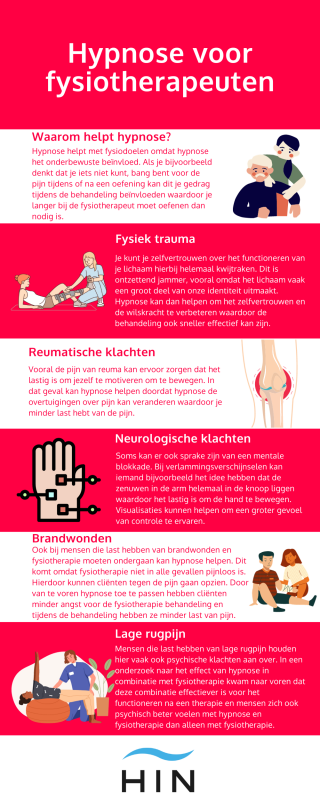
Also pin this handy infographic as a reminder:
Sources:
https://www.sciencedirect.com/science/article/pii/S1779012315002211