


Back pain is something everyone suffers from from time to time. Usually you can explain it by lifting something heavy or by sitting or lying in the wrong position for too long, but sometimes an explanation seems impossible to find. So could there still be a psychological cause for back pain?
Chronic back pain is sometimes treated with cognitive behavioral therapy, which can hint at a psychological cause. Read on if you want to learn more about this.
Cause of back pain
Back pain is usually caused by lifting too heavy a weight or just a dislocation of vertebrae in the back. In this case, it is also referred to as a herniated disc . With these types of physical causes, the complaint can often be resolved by rest and the pain goes away on its own.
But there are also people who suffer from chronic back pain. This may have started with the physical cause, but the fact that this pain does not go away does not really make sense at all. In that case, other causes of back pain should be looked at, such as a person's work posture.
Not only the actual sitting position, the importance of work on the psyche can also be important in identifying the cause of back pain.
In fact, chronic back pain often involves certain psychological symptoms as well.
Psychological complaints that occur with back pain
These symptoms are often caused by how people experience pain and the influence that pain has on the beliefs of those in pain. This then involves beliefs about how their life goes when they are in pain.
The psychological stress you can get from pain and the consequences of pain, such as not being able to move properly, can cause you to experience pain differently than you did in the first painful instance.
For example, if you are easily anxious and always assume the worst case scenario. When you mainly think about how bad it is and how badly the pain affects your life, this can make the pain much worse than it is. These psychological fears can change the way your brain works, making the pain feel much worse than it would without all those psychological fears.
With psychological problems even before pain occurs, those psychological problems can cause the brain to work differently than in people who do not have psychological problems. The functioning of chemicals, such as dopamine, may then be disrupted and how you react to stressful situations. This can make you anxious and assume that the pain will be the worst pain there is.
For some people, there doesn't even have to be a psychological problem first to make the pain worse than it is. The pain itself can do this, too. Especially with chronic pain, such as with a herniated disc, pain can change the way the pain part of the brain works, causing pain to act on emotions, such as anxiety, as well.
Back pain treatment
Precisely because of the effects of long-term pain, it is important to do something quickly to reduce the pain. Initially, painkillers are often considered. Meanwhile, there are also studies on the effect of antibiotics on back pain and on the effects of stimulating the nerves in the back.
Rest and exercise are also often recommended to do something about back pain.
Yoga, for example, is a form of exercise that can help reduce back pain for some people. This is because yoga helps people become stronger and gain more flexibility.
Thereby, yoga has the benefit of relaxing you and it works to reduce stress.
Research also shows that yoga has short- and long-term pain relief for people with chronic back pain.
Other forms of exercise can be as effective against back pain as yoga, though. So if you prefer swimming, walking or cycling, that is also good against back pain.
Strength training and help from a personal trainer can also help you reduce back pain. For example, the personal trainer can help you push boundaries that make you avoid situations that normally lead to pain less even outside of exercise, allowing you to discover that fear of pain in those situations is not necessary at all.
In the process, a personal trainer or physical therapist can show you how best to perform everyday movements to minimize back strain.
Psychic Treatment
As mentioned in the introduction, back pain is also treated with psychological treatments such as cognitive behavioral therapy (CBT).
Research shows that 8 sessions of CBT can lower the intensity of pain, reduce the beliefs people have about pain, reduce fears, and make people do something about pain more actively.
It also reduces depressive symptoms due to back pain.
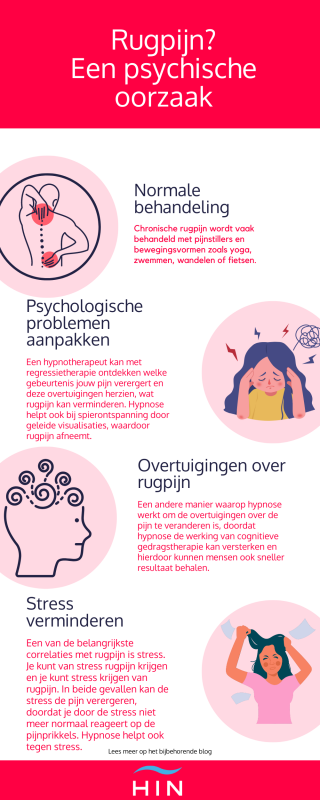
Addressing psychological problems
As mentioned, a psychological problem even before there is pain can cause you to deal with pain differently than people without serious psychological problems. It is important to eliminate such a problem.
This can also be done with cognitive behavioral therapy, such as through socratic conversations. Another way to find out what problem is causing pain stimuli not to be processed normally is through hypnotherapy.
A hypnotherapist can use regression therapy and other techniques to find out what event in your life caused you to not deal with pain normally, making that pain seem worse than it is.
Beliefs created by a traumatic situation are then reconsidered. This allows you to change them almost immediately, which also allows you to suffer less back pain immediately.
Hypnosis can also help you relax all the muscles in your body, which in turn helps with back pain. A hypnotherapist can do this with a guided visualization that focuses on relaxation. Initially, you then visualize a nice pleasant place where you can relax and then the hypnotherapist gradually helps you to relax all the muscles in your body.
With a mindfulness body scan, it is also possible to consciously relax all the muscles in your body, but if this doesn't work, a guided visualization like this can be just the extra bit you need to relax.
Changing beliefs about back pain
Another way hypnosis works to change beliefs about pain is because hypnosis can enhance the effect of cognitive behavioral therapy, and because of this, people can also get results faster.
If the techniques are performed while the person with back pain is under hypnosis, it can cause the subconscious mind and brain functioning to be influenced faster to suffer less from the back pain.
Changing beliefs about back pain can be done, for example, by repeating hypnotic suggestions to yourself during self-hypnosis. Before you do this, you need to take the following steps:
Step 1: Find a comfortable place in your home.
Step 2: Lie there and breathe through your abdomen.
Step 3: Close your eyes and try to relax all your muscles.
Step 4: Repeat hypnotic suggestions.
A hypnotherapist can help you with homework. Then you will receive hypnotic suggestions that apply to your beliefs and fears, such as:
If I'm not in pain, I don't worry about pain.
I can also live a normal life with pain.
When I pay attention to my posture, I have less pain.
Moving keeps my back flexible.
These are just examples, as mentioned, a therapist can help you use specific suggestions that apply to your beliefs.
Reduce stress for less pain
One of the main correlations with back pain is stress. You can get back pain from stress and you can get stress from back pain. In either case, the stress can make the pain worse, because the stress prevents you from responding normally to pain stimuli.
To reduce stress and thereby reduce back pain, psychological treatments also look at the effect of mindfulness on the pain experience. In doing so, mindfulness against stress also helps reduce anxiety and depressive symptoms.
With mindfulness, it is especially important to live in the here-and-now. Especially if you are someone who anticipates pain and starts thinking about how something is going to make your back pain worse, mindfulness can help reduce and stop these kinds of thoughts.
Want to learn more about how hypnosis and other mental techniques work to look at problems, such as pain, differently? Come visit thefree master class for an introduction.
Or register directly for one of our events or trainings.
Pin also includes this handy infographic as a reminder:
Sources:
http://www.sciencedirect.com/science/article/pii/000579679500008L
https://link.springer.com/chapter/10.1007/978-3-319-49022-9_8
http://www.imr-journal.com/article/S2213-4220(15)00367-4/abstract
http://www.webmd.com/back-pain/living-with-low-back-pain-11/emotional-effects?page=2



Natalie
on05 Sep 2019