


Fear of the dentist is understandable, but unhealthy. That bright light, sometimes the poking of the gums to check how healthy they still are, it's not always nice to be at the dentist. As a dentist, it is again annoying when people sit anxiously in the chair making treatment difficult. Especially if your patient has had an unpleasant experience, fear of the dentist is so born. Therefore, in this article I will discuss dental anxiety and what you as a dentist can do about it.
Fear of the dentist is real
Fear of the dentist is real, but that doesn't mean there's nothing you can do about it. Usually a bad experience in childhood at the dentist is the reason why people are afraid of the dentist. For example, a friend of mine finds it difficult to go to the dentist because the dentist she had when she was young simply pushed out her loose, but not yet loose enough, molars with his thumb. That was incredibly painful.
Other experiences include anesthesia not going well for a treatment after which a nerve was hit. Shoots of pain and even flashes in front of the eyes resulted. Because you are still forced by your parents to go to the dentist as a child and adolescent, people usually go to the dentist until around the age of 20, but for people with anxiety, the visit stops completely after that.
Sometimes the anxiety also did not stem from trauma at the dentist, but may bring back memories of other times when the person with anxiety had no control. Especially the lack of control is a problem for many people who are afraid of the dentist. After all, you're lying there in that bright light, with that dentist above you. Because of all the stuff he uses, you can't really talk, and therefore you or someone who is anxious feels like you have even less control than you already thought.
There are even people who dare not even drive past the dental office. Then, when you get a toothache, people with a fear of the dentist have no problem living with the pain. Rather pain than going to the dentist. The idea of going to the dentist may not even occur to anxious people. It is very wise for the health of your patients who have anxiety to do something against the fear of the dentist.
Bad teeth
After all, as a dentist, you check how healthy teeth and gums are. You obviously know what all the unpleasant effects are and would like to tell your clients the same. Bacteria that can still cause damage through the mouth to the brain, heart valve and all the other things I, as a hypnotist, don't know. Pointing out those harmful effects to your patient sometimes only increases their fear of the dentist. It works almost like packaging cigarettes, it's deadly and yet people keep smoking because you're going to die anyway. So with fear you cannot break the fear of the dentist.
Highlighting benefits can already work better.
- Removing the fear of the dentist ensures that the (ex) anxious person can take good care of their teeth again.
- Large and small moments of pain are eliminated through solid treatment, allowing the anxious person to simply go back to work without painful teeth.
- You help the person with anxiety enjoy clean teeth by getting them back to the dentist and dental hygienist.
Dental anesthesia
To overcome dental anxiety, people sometimes turn to violent means, such as treatment under full anesthesia. The bottom line is that anxious people sometimes prefer to be unconscious rather than conscious while the dentist is working.
People with anxiety sometimes would rather go under anesthesia than use a local anesthetic.
This is actually incredibly strange. Often there is a fear of losing control and then they give that control away completely. Even knee keyhole surgery uses only local anesthesia, with or without an epidural.
Anesthesia is also not harmless. After anesthesia, you may suffer from concentration problems, memory problems, fatigue and more vague complaints that interfere with your overall well-being. So on balance, you don't gain anything.
Fear of dentist tips
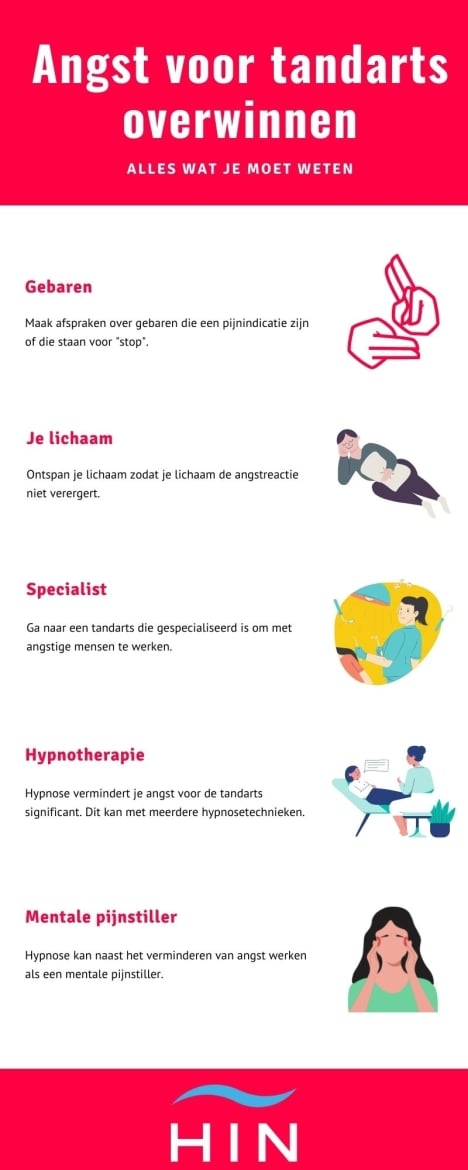
Before getting in the chair, agree on gestures the patient can give when they are in pain. Like, "I feel something but I can still have this" is a 1 finger in the air. "This hurts Mr. very much" is a whole hand in the air.
Allow the patient to relax. Anxiety is often exacerbated by the physical reaction. Relaxing with breathing exercises prevents the body from cramping and producing too much adrenaline because people actually want to "flee."
Have the patient take three counts of deep breaths through the nose and three counts of exhalations through the mouth. Repeat this beforehand to stay calm. On the dental chair, the patient can continue to breathe in this calm manner, but may find it helpful to do everything through the nose. By telling people this, you give them a sense of control.
Dental specialization with anxiety
A dentist who helps people who are afraid of the dentist will return the sense of control to the patient and also try to minimize the fear. This can sometimes already be seen in the waiting room where things have been removed that remind one of fear. For example, there are no informative pictures hanging about how teeth are put together.
Control is returned to the patient by agreeing in advance on signals when the dentist should stop or that breaks should be taken. In addition, the dentist can regularly ask to continue.
Relaxation exercises and hypnosis are also used by some dentists to reduce treatment anxiety.
Hypnosis to overcome dental anxiety
Research shows that dentist use of hypnosis can significantly reduce your fear of treatment. This is because hypnosis can be used not only for dental anxiety, but also as a kind of mental pain reliever.
In fact, before local painkillers existed, hypnosis was used to help patients reduce pain or, conversely, not focus on pain.
Before applying hypnosis to a patient as a dentist, it is important to know his attitude toward hypnosis. If he does not have a good attitude toward it, you can suggest performing relaxation exercises. Otherwise, the patient will resist hypnosis making your attempts to help him unsuccessful.
Hypnosis can be used in three ways to reduce dental anxiety.
First, hypnosis can be used during treatment as a relaxation exercise and to make the person less sensitive to the actions you perform as a dentist. Relaxation is incompatible with anxiety, and relaxation also increases the pain threshold.
With various hypnosis techniques, you can maintain and further deepen relaxation during treatment. For example, you can give suggestions that distract from the anxiety away and stimulate the patient's imagination. In this way, you keep the patient focused on something other than the anxiety.
Second, hypnosis can be used upfront to give the patient tools to better cope with treatment. You can then provide the patient with strategies to better manage anxiety during treatment.
Third, hypnosis can be used to change the perception of fear, the beliefs that created the fear.
One of my favorite hypnotherapies is regression. If previous techniques don't work, a hypnotherapist can use this technique. With regression, you go back to the moment where the fear of the dentist arose. Where that person's belief arose that made them suddenly afraid of the dentist.
Oddly enough, then, this doesn't always have to be a fearful moment at the dentist. Sometimes fear of the dentist is a symptom of something else, such as a disturbed relationship. Through regression therapy, you can find out what is blocking the patient from going to the dentist. Then you can give tools to deal with that moment differently so that the person is no longer anxious about the dentist.
Helping others who are afraid of the dentist
Are you a dentist or a beginning (or even advanced) hypnotherapist interested in helping people overcome their fear of the dentist? Then check out the Hypnosis Institute Netherlands' trainings, events and webinars for more information.
Also pin this handy infographic as a reminder:
Sources:
http://www.webmd.com/oral-health/features/dont-fear-the-dentist



