
You're sitting at the table with your partner. He asks you to pick up his mother from the airport tomorrow morning at six o'clock. You had other plans, but you hear yourself say, "Of course, no problem." Again you do it. You say yes when you mean no.
Perhaps you recognize this feeling. You adapt yourself to what others want, avoid conflict and put yourself second. This happens so automatically that you don't even think about it. It's just what you do.
This response has a name: fawn. It may sound like something out of a psychology book, but it's much more common than you think. Many people do this without realizing what is actually happening.
Now you may be thinking, "But I'm just being nice. What's wrong with that?" I get that. It also looks like kindness. Keltner and his colleagues investigated this and discovered three different forms: submissive expressions, connective expressions and inhibition [2].
All of these behaviors have a function in relationships, but not always a healthy one.
The difference is here: true kindness is a choice. Fawn is an automatic response of your body when you feel threatened. You don't have a fawn reaction, you do fawn. And that's actually good news, because what you do you can learn to do differently.
Often this reaction stems from childhood experiences or trauma. In complex post-traumatic stress disorder (cPTSD), a diagnosis that affects 36% of people in the mental health system, you often see this pattern [3].
But here's the good news: You don't have to stay stuck in these patterns. You can learn to respond differently. Hypnosis can be a powerful tool for this, something we'll discuss in more detail in a moment.
Why am I telling you this? Because you've probably thought for a very long time that this is just who you are. That you are always so accommodating, so helpful, so conflict-avoiding. But you're not necessarily that. That's what you do. And that means you can start doing something else, too.
How do you recognize this pattern in yourself?
Your body often knows before your head does. When you feel threatened and fight or flight is not an option, your nervous system automatically switches to another strategy: be compliant. It happens so quickly that you're not even aware of it. But how do you notice that you are doing this?
What happens in your relationships
Let me give an example. Sandra sits in my practice and talks about her relationship. "He always asks if I like what we're going to do," she says. "And I always say yes." But then comes the hesitation. "Even when I don't feel like it at all."
Recognize this? You say yes when you mean no. You agree to plans you don't really feel like doing. Why? To avoid conflict. You feel responsible for other people's moods and it's exhausting.
Your body betrays you, too. That forced smile, that tension around your eyes, that exaggerated politeness. They are all signals. You are hyper-aware of what your partner is feeling, but what are you actually feeling? You often don't even remember that.
At work and with friends
Friday, four o'clock. You're ready to go home. You have plans with your kids. Then your boss comes over. "Can you finish that presentation? It won't be needed until Monday."
What do you say, "Sure, no problem." While inside you think: there go my plans. This is not voluntarism; this is an automatic response. Your body has decided that going along is safer than saying no.
With friends, you do the same thing. You anticipate what they need before they know it themselves. You are always ready, always alert. And that takes energy, more than you realize. Your mind is constantly on, and it's exhausting.
Why people don't see it
People around you love you. You are so kind, so helpful, so loyal. "What a sweetheart you are," you often hear. And that's true, you are sweet. But what they don't see is the price you pay.
The difference between being really nice and doing fawn? In being kind, you make a conscious choice. You help because you want to. With fawn, it's an unconscious stress reaction. You do it because your body considers it safer than the alternatives.
Women in particular often receive compliments for this behavior. "How caring you are," it is said. And that makes it even harder to recognize that it's actually a survival strategy. You are being rewarded for something that exhausts you.
The ironic thing is this: your environment only sees your friendly side. You feel the exhaustion, the sense that you have lost yourself, the frustration when you have once again said yes when you meant no. You don't see that until it really bothers you.
Where does this come from? Your earliest survival lessons
Let's go back to the beginning for a moment. Imagine you are four years old and your mother is having another bad day. You don't know how to name it, of course, but you sense that something isn't right. The atmosphere in the house is tense. You soon learn: if I am just very good, very quiet, then maybe things will get better.
That four-year-old didn't yet know he was developing a survival strategy. He was just doing what worked.
When safety is lacking
Fawn usually arises where safe attachment is lacking. And that doesn't even necessarily have to be drama. Maybe you had parents who were emotionally unpredictable. One day you got a hug for something, the next you were scolded for the exact same behavior.
Or you had a mother who was struggling after a divorce and you suddenly became the adult in the house. You learned: as long as I take good care of Mom, she will continue to love me. Insecurely attached relationships, where love feels conditional, are often the basis for this response.
You discovered that the less you stand out, the safer it is. That makes sense, because as a child you are completely dependent on your caregivers. You can't just walk away when things are difficult at home.
When fight and flight are not an option
Evolutionarily speaking, fawn is brilliantly conceived. Back when we lived in tribes, being thrown out of the group meant almost certain death. Survival alone was not realistic. So what did your body do? It chose the strategy that maintained social connection: go along with the group, adapt yourself, avoid conflict.
Your brain decides this in a split second. When the amygdala, your internal alarm system, detects danger, it immediately switches to the safest option. And for a child, that's often: just do what the adults want.
How you learned this as a child
Perhaps you recognize yourself in one of these situations:
- You had to grow up early because mom or dad was struggling
- You grew up with a sibling who demanded all the attention, so you became the "easy" kid
- At home you were not allowed to express emotions, so you learned to put them away
- You experienced insecurity, physically or emotionally, and being compliant seemed like the best protection
Especially children with sensitive nervous systems develop this pattern quickly. Gifted or highly sensitive children pick up on subtle cues much more strongly. They sense tension in the room before others realize it.
The interesting thing is: that strategy worked back then. You survived your childhood, you retained your parents' love (or what passed for it), you avoided many conflicts. That four-year-old did exactly what he had to do.
Only now you are no longer four. That threat from before is no longer there, but your body still reacts as if it is. It's like carrying an umbrella all your life because it rained once.
Fortunately, you can learn new patterns. Your body can learn that it is now safe to react differently. We'll talk about that in a minute.
What happens if you keep doing this?
You may be thinking, "But it works, right? Everyone likes me, there are no conflicts." I get that. In the short term, this pattern of behavior does indeed seem to bring harmony. But what happens in the long run is less pleasant.
That survival strategy you once protected? That one is eventually going to destroy you.
You lose yourself
Last year I spoke to a woman who said, "I don't even know what I like to eat anymore. I always order what my husband wants." That's what happens when you continually suppress your own needs. You become alienated from your emotions, your desires, your boundaries.
You no longer feel your own boundaries. Where does the other person stop and where do you start? This becomes increasingly unclear. To others you always seem friendly and accommodating, but inside you get lost further and further from who you really are.
Making choices for yourself becomes difficult. What do you really want? You've done what others wanted for so long that you no longer know the answer to that question. And that affects your self-image. You start doubting your own worth.
Your body is not holding up
Your body is constantly on alert. Always alert to signals from others. Always working to prevent conflict before it arises. That takes a ridiculous amount of energy.
Think your body can sustain that endlessly? No way. You can develop chronic fatigue, get headaches, muscle aches, sleep problems. Your immune system weakens. Hormones get upset.
Many people who function this way run straight into burnout. And then everyone looks surprised, "But you always seemed so calm, so balanced." Yes, it seemed that way. But being calm and suppressing stress are two very different things.
Those suppressed emotions have to go somewhere
What do you do with your anger? With your frustration? With those times when you actually wanted to say, "No, I don't take this"? Those feelings don't disappear because you don't express them.
They build up under the surface. Until one day you explode over something small. Your partner drops a cup and you scream at him. Or you burst into tears because the cash register at the supermarket isn't working.
Then everyone looks puzzled. "What's wrong with her? She's acting so weird." And you feel guilty. Again you didn't do a good job. Again you disappointed someone.
After such an outburst often come feelings of shame and self-blame. You have let yourself down again. This pattern can lead to depression, anxiety disorders and chronic stress. And I don't begrudge you that.
There has to be a better way. And there is.
Hypnosis as a way out
Imagine years of pushing against a door that was locked, with the key in your pocket the whole time. That's often how it feels with fawn patterns. You try all kinds of things to change, but those automatic reactions keep coming back. Hypnosis can be that key.
So why does hypnosis work? It goes straight to your subconscious mind, exactly where all those automatic reactions originated. You may understand with your mind that you are allowed to set limits, but your body still reacts as if you are in danger. Hypnosis helps to actually get that message to your subconscious.
What Actually Happens.
Your subconscious mind is not stupid. It once developed these patterns to protect you. As a child, going along may really have been the safest option. But now you are no longer a child and yet your body continues to pretend that it is.
During hypnosis, you enter a relaxed state in which your subconscious mind becomes more accessible. That is precisely where those old survival strategies are stored. Research shows that hypnosis can provide significant improvement in trauma-related complaints after only two months [1].
A hypnotherapist can work with that root, not just what you see on the surface. It involves:
- Detecting beliefs that are holding you back
- Releasing emotions that are stuck
- Really change thinking patterns, not just understand them
Hypnotherapy uses targeted suggestions to reprogram your subconscious mind so that you react differently in situations where you previously automatically fawned [2].
Safety first
Here's something important: You never lose control during hypnosis. You can always come out of the trance by yourself [3]. This is essential, because fawn arose precisely because of a lack of safety. A good hypnotherapist creates an environment in which your subconscious can open up without fear.
What does a session Look Like?
It usually begins with an explanation of what will happen. This is followed by a relaxation phase in which you go into trance. You do remain just conscious; hypnosis is not sleep. Then the therapist works with suggestions that help you develop new, healthier responses.
The great thing is that afterwards, you often find that situations that previously stressed you suddenly feel different. Not because you thought about it rationally, but because your subconscious mind is now responding differently.
You don't have a fawn response, you do fawn. And what you do, you can learn to do differently. Hypnosis helps you do that at the level where it really counts.
You can really do something about this
Now you know. You recognize those moments when you say "yes" when you mean "no. Those times when you push yourself away to keep others happy. That feeling that you've lost yourself somewhere along the way.
You may now be thinking, "Okay, so now what? I've been doing this for so long, can I get rid of this?" The answer is yes. You really can do something about this. Why? Because you're doing it. You don't have a fawn response locked into your DNA. You do fawn, and what you do you can learn to do differently.
That doesn't mean it's going to be easy. These patterns run deep and were created when you were young, to protect yourself. But protection that used to be necessary can actually get in the way now. It's like still wearing a winter coat when it has become summer.
Hypnosis can help with this because it works directly on where these automatic reactions originated. Not by telling you what to do, but by helping you discover what you actually want to do. By letting you feel what it is like to react from safety instead of fear.
What does that mean for you? It means you can learn to say "no" without your whole world collapsing. It means you can learn to check with yourself what you want before you answer. It means you can remain kind out of choice, not fear.
You don't have to worry about suddenly becoming an egotistical, unfriendly person. On the contrary. When you are kind out of genuine choice, it feels much more real to others than when you do it out of fear. People feel that difference, even if they can't always name it.
The great thing is: you don't have to do this alone. There are therapists who can help you. There are techniques that work. And most of all: there is hope. Thousands of people have learned to respond differently than they were used to for years.
So where do you start? With acknowledging that you are doing this. With accepting that it's okay that you did this - it helped you survive. And with deciding that you now want to learn something else.
You are worth being seen and heard for who you really are. You are worth saying "no" when you mean no. And yes, you can learn to do this. Step by step.
Learn Hypnosis
Want to learn hypnosis for yourself, or already know you want to help people with it? Come to our free master class.
Or register directly for one of our trainings and events.
Have a question about the training? Schedule a 1-on-1 consultation here.
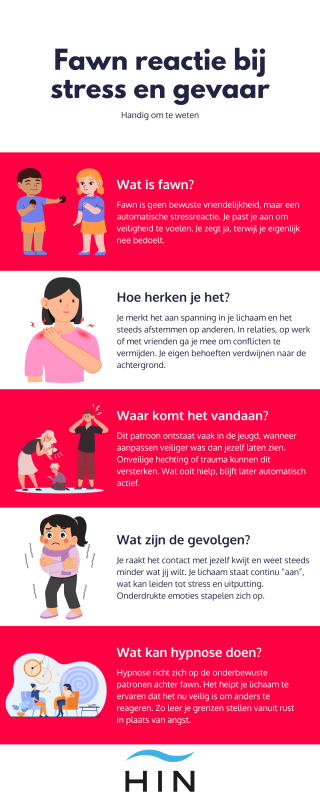
Pin this handy infographic as a reminder:
References
[1] - https://www.tandfonline.com/doi/full/10.1080/20008066.2023.2183005
[2] - https://mentalhealth.bmj.com/content/27/1/e301240
[3] - https://www.tandfonline.com/doi/abs/10.1080/10720160802035584