


Having anxiety is annoying, but if your partner suffers from anxiety, it can also be very annoying. You feel like you have to reassure or even protect him/her all the time. Or perhaps you do begin to feel irritated that your partner has a phobia that makes no sense no matter what you say about it. You may take on all kinds of roles because of the anxiety, but it doesn't seem to help and you are now experiencing stress from it, too.
To ensure that you can better cope with your partner's anxiety and reduce stress yourself.
I know a very beautiful story of a partner whose wife was afraid of spiders. Really if she saw a spider she screamed at it. So for the next while she would not come into the room where the spider had been spotted, even though the spider had been removed.
While on vacation in Spain, the husband and her son found out that around the vacation home where they were there were super large spiders. So they had a life-size problem, because if they found out then it meant that the vacation in that house was over. So they went spider hunting every morning before she woke up to make sure there was no spider and no trace of the spiders left.
They have maintained this every day throughout the vacations.
They didn't have to look up another address or go home earlier, and this man's wife also enjoyed the vacation wonderfully.
Now, fear of spiders is not a big problem yet and you can still see the humor in this, but if your partner has an anxiety disorder that is more mental you can't do as much to make sure they don't face the fear.
Helping your partner can reduce depression and anxiety in your partner, especially if this involves parenting(1).
That's why I'm going to give you some tips.
Tip 1: Delve into your partner's fears
By this I don't mean that you should totally question your partner about his/her anxiety. However, it is helpful if you know exactly what he/she is anxious about so that you can delve into this anxiety.
There are several types of fears, for example, fear of things, such as the fear of spiders or cats. You can also be fearful of events or social interactions, such as flying.
If you know what your partner has anxiety issues with, you can delve into that anxiety. On wikipedia, for example, there is a lot of information about anxiety. In addition, you can look at how anxiety is generally treated.
Anxiety, for example, is often treated with cognitive behavioral therapy combined with hypnosis.
Tip #2: Don't help your partner hold the anxiety
The example I showed at the beginning is actually the way to maintain fear. If your partner has a fear of driving and therefore expects you to drive him/her to something every time while you also have things to do this can be very annoying.
Sometimes that's exactly when you have to choose for yourself. This requires your partner to confront his/her fear(2).
Often, you also want your partner to recognize that the fear is not helpful. For example, when it comes to social anxiety, most people say this, "You shouldn't worry about what other people say about you." This is a logical statement, but will not really have the desired effect.
Instead, you can point out to your partner that anxiety is causing the achievement of certain life goals, such as happiness, work and independence, to be hindered.
For example, you can say, "I worry that your anxiety about what other people think of you is holding you back at work."
This directly identifies the problem causing the anxiety and can increase the chances of finding a solution to the anxiety.
Tip 3: Accept that you can't always do something
Ultimately, your partner is the person who has a problem. Your partner has certain thoughts and beliefs that are causing the anxiety. You can't always do anything about this. If the second tip does not help, you have to accept that you are not the prince(s) on the white horse.
If your partner is having a panic attack , you can only be there for him/her.
When your partner has a panic attack, he/she gets a whole bunch of stress hormones and adrenaline all at once. It is as if the brain signals the body to start fighting or fleeing. If there is no obvious reason for this, such as a scary dog, this is sometimes very difficult to process.
In that case, you can go for a walk or do yoga. Through a physical response, your partner's body also immediately consumes the hormones, which can make the panic attack go away faster.
Walking in public may be the best solution, for example, if your partner has a panic attack while shopping.
Tip 4: Set boundaries
Getting up earlier in the morning than your wife for the entire vacation to clean up spiders around your vacation home is not the image most people have of an enjoyable vacation. Sleeping in is often out of the question and that is something you want on your vacation. Fortunately, this was only a temporary problem.
If your partner's problem is less temporary, you may notice that your boundaries are being crossed all the time. You want to meet up with friends and girlfriends, but your partner then starts talking about loneliness. You are in a hurry for an appointment, but your partner also has an important appointment and you have to take him/her there by car first.
This can cause you to lose your grip a bit. So it's important to point out that you have a life, too, and you don't want it to be negatively affected by anxiety(3).
Tip 5: Do fun things together
To reduce anxiety, you can also do fun things together. Exercising together, going to the movies, eating out or going to something together that relaxes you.
If this is a walk, that's okay, too.
Doing fun things together allows you to relax and strengthen the bond. This is important because your partner's anxiety can sometimes weaken that bond slightly, when it is not necessary at all.
Tip #6: Use mindfulness in your relationship
While you're busy doing fun things together, use mindfulness in your relationship. Using mindfulness in your relationship also strengthens the bond you have with each other.
In the process, mindfulness can also help well against anxiety. So it is important that your partner joins the mindfulness.
There are also techniques you can perform together. For example, you can help your partner with the mindfulness body scan. Instead of him/her performing the body scan himself/herself, you can guide him/her in it. For example, you indicate which body part should be scanned.
This helps your partner relax and be in the here and now with their thoughts instead of with the anxiety.
Tip 7: Take care of yourself, too
Taking care of your partner is very noble, but if you don't also take good care of yourself, it doesn't always have the effect you want. It is therefore important that you also do things that make you happy and healthy. If you want to exercise you just have to.
If you enjoy going to the hairdresser or beautician every now and then for a pampering moment you just have to do it.
It's important to take care of your body and mind so you don't get unnecessary tension in your relationship.
You cannot take care of another until you take good care of yourself. You can't love another until you love yourself.
What to do if your partner won't let you treat the anxiety
Anxieties can be treated very easily, for example with hypnotherapy and cognitive behavioral therapy (CBT). I myself help people get rid of fears daily, whether it is for dogs or for making a presentation.
If your partner does not want treatment it will not help to keep insisting. He/she must make the choice to want treatment himself/herself. Once that choice is made, it is important to support your partner in this.
In hypnotherapy, for example, your partner can receive homework in the form of self-hypnosis. This can be separate at first because he/she has to relax and repeat hypnotic suggestions aloud. If your partner prefers to do this while he/she is home alone it is best to leave for a while.
Of course, if your partner specifically wants help you repeat the suggestions can also be of great help to your partner.
Want to learn more about mental techniques to reduce anxiety for yourself or your partner? Then check out Hypnosis Institute Netherlands' training courses or come to the free online master class on hypnosis.
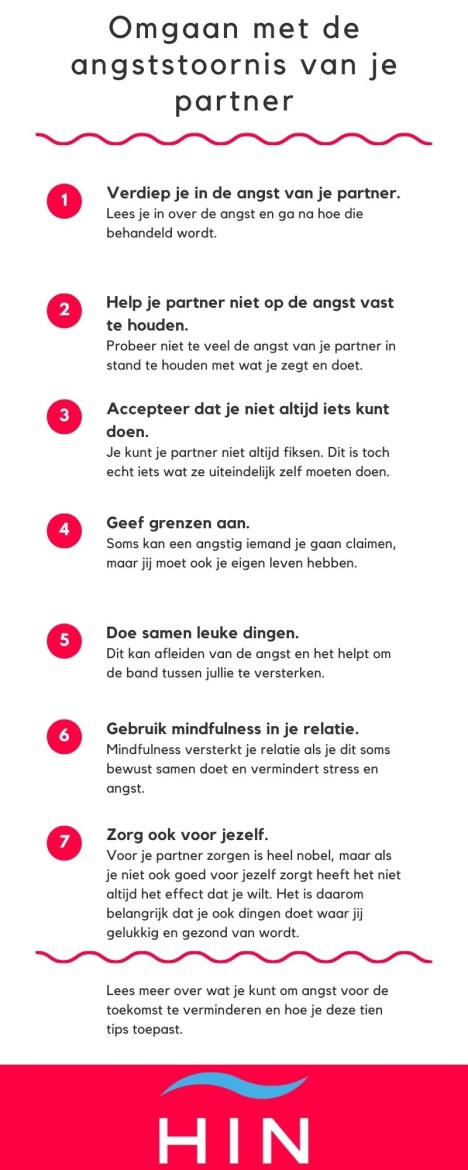
Also pin this handy infographic as a reminder:
Sources:
- https://link.springer.com/article/10.1186/s12888-016-0721-0
- https://psychcentral.com/blog/how-to-support-an-anxious-partner/
- https://www.psychologytoday.com/us/blog/hi-anxiety/201611/7-tips-supporting-romantic-partner-anxiety