


Have you ever been under hypnosis? I know a story of an inveterate smoker who wanted to give hypnosis a chance after 55 years. Almost immediately after the session, he told his wife that it hadn't helped, but she noted that he hadn't touched a cigarette since. So what hypnosis is and how you know if it has worked is very different from what most people think.
Therefore, in this article I will discuss what hypnosis is, how to know if you are (have been) under hypnosis and when you notice that hypnosis has worked.
What is hypnosis?
"It didn't work, I wasn't under hypnosis." A comment many people may make after seeing a hypnotherapist. Many people's perception of hypnosis is that you are completely gone, that you therefore do not remember what you are doing AND when you are out of hypnosis you cannot remember it.
Of course, the hypnosis shows that were once popular created quite a few assumptions in people's homes.
This doesn't add up. If you hear and remember everything the hypnotherapist says, that's exactly the point.
Being under hypnosis is not something akin to hallucinating or any other trip. Hypnosis is not similar to using drugs, but safer.
Hypnosis is a mental state that enhances psychotherapy.
During hypnosis, you are in a kind of trance that allows you to go along with the suggestions the therapist gives you. During that trance, you are neither unconscious nor asleep. Instead, you are in a deep relaxation that allows your brain to focus on 1 goal and makes you more likely to accept suggestions from the therapist that will help you achieve your goal, such as quitting smoking or getting rid of fear of flying.
So if you think you should experience some kind of trip during hypnosis you will be deceived. People who can focus well are often good hypnotists, too.
In the process, your own opinion toward hypnosis is also important. The majority of people can be hypnotized, even if you think it's fake, but if you have a more positive attitude toward it, it works better. Research shows that 30% of people find it difficult to get into hypnosis, but with some help from the hypnotherapist it is possible for them too.
If you don't want to be hypnotized then you won't succeed. So if you think it's fake but you still want to give it a chance it works better than if you think hypnosis works but you just don't want to be under hypnosis.
Hypnosis can also only help you if you really stand behind the goals you want to use hypnosis for. So if you really want to quit smoking, but don't actually believe in hypnosis, it can still work.
When are you in hypnosis?
So how do you know if you are in hypnosis? Actually, it is the hypnotherapist's job to check if you are in hypnosis. There are a number of ways to induce hypnosis. Induction is what we also call it. Then if you show slight signs of being in hypnosis the hypnotherapist will deepen it before the real therapy begins.
In any case, you will be in a deep state of relaxation during hypnosis. For example, you may lie down during hypnosis, or you may be hypnotized while standing. You'll notice that your breathing deepens and your muscles relax. You may even notice that your heart rate slows down.
During hypnosis, you also notice that you have become somewhat docile. The hypnotherapist also tests this by having you do things, such as lift your hand. Crazy things you won't do, of course, because you simply retain your own norms and values that determine whether or not you do something, and crazy things a good hypnotherapist will never suggest either.
Therapy begins when you are in hypnosis, then the hypnotherapist will begin to focus on the goals you came to him with. The focus on this goal and therapy may seem familiar to you. In fact, the feeling is similar to the feeling when you are very fanatically working on something and not paying attention to anything else. The feeling that you can be completely absorbed in your own thoughts. That you are just completely satisfied in the now and are not thinking about the future or the past. It also resembles the state you are in during meditation.
When you are in that zone, the hypnotherapist will begin treatment and guide your thoughts to where previously no one was leading you to those thoughts.
Then, for example, the hypnotherapist can perform regression to find out with you where a problem has arisen.
During therapy, the hypnotherapist will help you with visualizations. You then notice that you can become completely absorbed in the visualization that the therapist presents to you. You will find it easier than usual to imagine something going well, such as staying calm during the takeoff and landing of an airplane or cleaning up a spider.
Suggestions the therapist gives you about your own beliefs are now suddenly less strange, perhaps even logical. A thought that is different from your own or an idea that for once you don't immediately reject when your friends may have said the same thing.
After therapy, the hypnotherapist will bring you out of hypnosis. So out of that trance and state of focus on your goal. This is good to conclude that you were working on that goal during therapy, but you may find it reassuring that you can't stay in hypnosis anyway, as said it is not a drug. If you couldn't get out of hypnosis you wouldn't be able to stop meditating or working when you're in the flow either and we know that anyone can say that enough is enough now if you've been working full of focus for a while and meditation is going to get boring at some point anyway.
When will you know if hypnosis has worked?
Of course, you want to feel immediately after hypnosis that it has worked. For some, the effect is obvious faster than for others.
I myself went under hypnosis for a problem and immediately realized that I was rid of my addiction. I found this so extraordinary that it inspired me to help more people with hypnosis. Then I found out that that was not enough and there were actually too few hypnotherapists to help everyone, but that aside.
For some people, the effect is immediate, but for others it may take a little longer. Therefore, there can also be the misconception that hypnosis did not work, when in fact it did work. In the example of the inveterate smoker, the effect may not dawn on the person until he realizes after a week that he has not smoked for a week without effort. Quitting smoking suddenly appears effortless.
If you have been under hypnosis to get rid of fear of flying , the effect may not be apparent until you travel by plane again. So with fears, the effect of hypnosis can only become apparent during an actual confrontation with the fear.
In short
The idea that you have not been under hypnosis because you have taken in everything the hypnotherapist said is not true. On the contrary, the idea is that you get everything the therapist has said to you.
You are under hypnosis when you are relaxed and focused on the goal you went to the hypnotherapist with. This also allows you to better focus on what the hypnotherapist is doing to help you achieve your goal.
In some cases, people know immediately that hypnotherapy has helped rid them of a problem. In other cases, you don't notice it until after a while because you weren't aware that it was working. This is also very typical because hypnosis works precisely on your subconscious.
If you are receiving hypnotherapy because of a fear, a confrontation with that fear and your reaction to it is a good indicator of whether the hypnotherapy has helped.
Want to learn more about how hypnosis works? Then check out the Hypnosis Institute Netherlands' events and trainings.
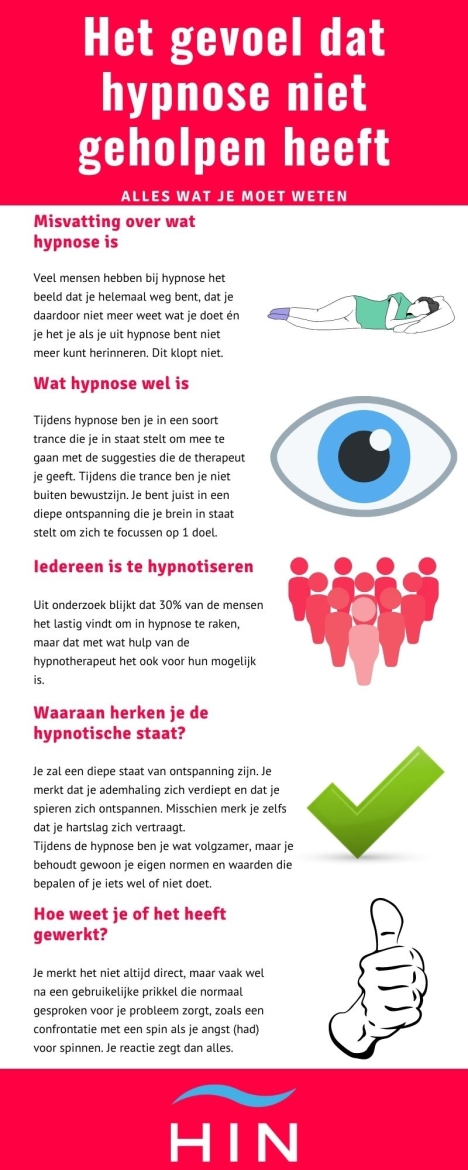
Also pin this handy infographic as a reminder:
Sources:
http://www.fairmountassociates.com/articles/The-Possibilities-in-Hypnosis.pdf