Many people believe something only after seeing it. "Seeing first then believing," is a very well-known saying. But it can also be the other way around, you can also believe first and then go and see it. That may sound a little crazy, which is why I'm going to elaborate a little.
I also heard this a lot when I became a Reiki master. In that I also gave some courses to colleagues in construction and they thought the same. Or even first experience and then believe.
What do you actually see?
So, because you see something, but how you interpret what you see depends on your focus. What you notice depends on where your mindset goes.
That's why you can turn it around. That you don't see something until you believe it.
This was very clear to me when my wife was pregnant. Suddenly I saw pregnant women everywhere, because that was where my focus was.
I also believed I was good at judging when a woman was pregnant or not. Well, I found that out when I stood behind a fuller-figured woman in the store and very enthusiastically said, "How long do you have left?" So that didn't go over well. I got a scathing look back. Of course.
But so I believed it at first, and so then I saw what I thought I saw.
When do you believe something?
Most people don't believe something until they've seen it, but there's also a lot of belief that comes from home. After all, children believe in St. Nicholas or Santa Claus because their parents tell them he exists.
Even if St. Nicholas doesn't come to you, you believe in him. Your parents wouldn't lie to you, would they?
In the West it is very normal to prove everything empirically, which is why this slogan is so embedded in our language, but in other cultures magical thinking is a much bigger part. This means that you can believe in something without actually seeing or grasping it.
But in some Asian countries, such as Indonesia, magical thinking is much more normal and occurs in all levels of society[1]. So there, first believe and then see is already much more normal than here.
So it is definitely possible for people to first believe something and then see it.
Then there is also the idea that if you believe something it has some kind of purpose. For example, you believe in a god because this gives you peace of mind that there is a higher power watching over you that everything is going well, that you can handle the challenges on your path or that you can learn from them. Then you can experience all kinds of things and if you experience enough, this belief can cause you to see this as a truth. So even then you first believe before you see it as something that is "true."[2]
What do you believe about yourself?
It's the same way for yourself. You first believe you can do it and then you start learning. When you are small you really do believe that you can do math or at least that you can learn it. Because what happens if you don't believe you can do it? Then you don't even try to learn it.
First Believe is therefore a very good foundation for your own development.
What do you want to believe about yourself? What do you want to believe about people or the world? What do you want to believe about your work?
When you get started with this, you start to see what you want to believe. What you don't believe is often deleted, so to speak.
In the spiritual world, they also often say that when you see someone who is irritated, it is your own irritation. This is true in itself.
For example, I once helped someone who had some autism issues. He found it difficult to feel emotions. If someone is angry with you, you know it because you see and hear it and maybe you feel it too.
That person wasn't feeling it. He really had to learn that when people talk and look a certain way, they are angry. As a result, he was tremendously good at sensory perception of people. He did that much better than I did, because he had to.
That intrigued me, because I thought I was good at that too since it is also required during hypnotherapy. But it intrigued me because he just didn't know if someone was angry or sad. He didn't feel anything about that either.
Because he doesn't experience that, that feeling, he doesn't always see it either. Now that may be strange because he learned it himself.
He doesn't really get angry himself, so he doesn't really feel that way about other people. He only "sees" emotionless people, but he "knows" it is not so.
Surely he processes this differently than most individuals.
So how can you recognize something if you don't have it in you yourself? If you think about that, what don't you want to see in your world anymore?
Why do you see what you see when you really don't want to see it? What causes me to believe something that makes it in my world.
When my wife was pregnant I also saw young parents and strollers everywhere, now I don't see them. Of course I do occasionally, but not very often at all. I don't notice them anymore.
Now it all makes pretty good sense when you think about it.
But when you think about it, it's super interesting that there are many realities, but they are only "presented" to us if we believe in them or if we are like that.
We are young parents, so we see young parents. This sounds logical, it's all true, but if you think it through you'll come to the principle:
Honor believe or be and then see.
Just like when you have or are looking for a new car and you have a certain model in your mind, you suddenly see that car everywhere. Your focus is then more on that and your brain signals to you faster that that car is nearby than when you are not looking at it.
Also listen to this podcast:
https://www.buzzsprout.com/195236/2418434-eerst-geloven-dan-zien?play=true
Setting goals or being something to believe it?
Setting goals also helps with this, but also think about who you become when you achieve the goal. If you are someone already to achieve the goal, then it becomes much easier to achieve that goal.
A famous quote is also, "Dress for the job you want, not the job you have." (Dress for the job you want, not the job you have).
In fact, this has multiple effects. For example, research shows that if a person dresses in business attire it promotes abstract thinking, so if that is important to the goal you want to achieve, clothing can even make a difference. Perhaps also because clothing is a signal of your identity, apparently so not only to your environment, but even to yourself.
Men in formal attire can even negotiate better and their testosterone levels are higher than when they wear their everyday clog.
Wearing a white lab coat (one of those you used to have to put on with tests in chemistry) allows for better focus and making fewer mistakes.
Athletes who wear red clothing instead of blue clothing can carry more weight and have a higher heart rate (they don't win more often, by the way).
Just be careful not to buy fake brand clothing to look good. In fact, research also shows that this makes you more suspicious of other people and more likely to do something unethical, such as cheating[3].
Removing blockages
Now you may be thinking, yes but I can never believe that I can (or learn) anything or that you are not worth investing in more expensive clothes or anything like that. That would be very unfortunate because then you will continue to have less fun things in your life.
Fortunately, there is something you can do about it. For example, you can use hypnosis (or self-hypnosis) to start focusing more on what you do want in your life. Even if right now you don't believe you can do it.
A hypnotherapist can then help you figure out the beliefs that are preventing you from believing you can or can still learn something. There are several techniques for this.
Depending on the problem or goal you have, quick techniques that primarily use metaphors and visualizations can be used, such as the SWISH technique. Or slightly more elaborate techniques such as regression can be used.
With regression, you go back to the moment when a blockage occurred and resolve it so that it no longer bothers you.
Want to know how this works? Then come to a free online master class on hypnosis.
Or enroll directly in one of our trainings to help yourself and others believe the best in their lives.
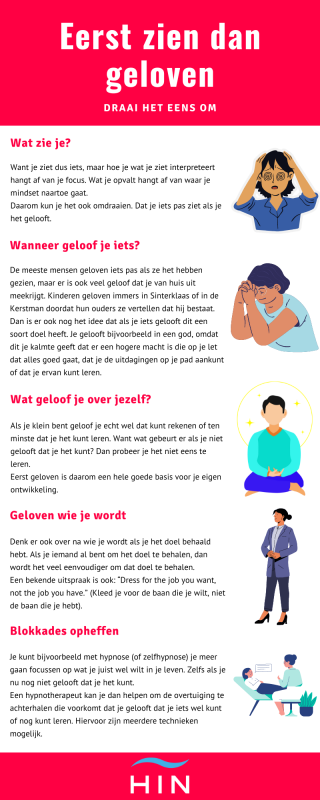
Also pin this handy infographic as a reminder:
Sources:
[1] https://espace.library.uq.edu.au/view/UQ:d448f31
[2] https://onlinelibrary.wiley.com/doi/abs/10.1111/j.1746-8361.2011.01270.x
[3] http://www.carolinebrooks.org/SLS1101/MODULE%2010%20Dress%20For%20Success%20Ethics/Dress%20For%20Success%20How%20Clothes%20Influence%20Our%20Performance.pdf