


A panic attack is super annoying. After all, it makes you think you're really dying, and that fear of death is just tough to live with. You are not the only one who has panic attacks. 70% of people suffer from them every year.
About 4% of the Dutch population suffers from a panic disorder. That's still 1 in 25 people. Women suffer from it 3 times more often than men. You can suffer from panic attacks at any age, but usually it starts when you are between 20 and 40 years old[1].
Symptoms of a panic attack
So how do you know if you're having a panic attack? There are a number of ways you can recognize a panic attack, namely:
- You suffer from intense anxiety.
- There is no obvious cause for your anxiety or its intensity.
- You fear losing control.
- You're afraid of dying.
- Your heart is beating very fast.
- You sweat more than usual.
- You vibrate.
- You're hot or cold.
- You are nauseated.
- You have stomach cramps.
- You have chest pain.
- You have a headache.
- You feel dizzy or lightheaded and are afraid you might pass out.
- You feel like you're not in reality.
This, of course, is incredibly annoying. Most people only get a panic attack once or twice in their lifetime, but when you suffer from it more often, you suffer from panic disorder[2].
Panic Disorder
You suffer from panic disorder when you regularly experience panic attacks. You then get anxiety about the fear of having a panic attack. As a result, you live in constant stress and anxiety, drastically lowering your well-being.
To suffer as little of this as possible, you can become isolated, simply because you don't dare to leave your safe house. Often you also get anxiety, such as fear of driving. Or the fear of driving into tunnels.
Having a panic disorder has a major impact on your life. As a result, it is often more difficult to hold down a job. This can cause you financial problems. In addition, you may seek a way out in drugs, which ultimately does not make your life any easier either.
Ultimately, it can depress you(source 1).
Why do you get panic attacks?
It is not always clear why you have a panic attack. It can be due to several factors, namely:
Your genes.
Having panic disorder may run in your family. If one of your parents suffers from it, you too are more likely to develop panic disorder.
Appalling stress.
For example, the death or divorce of a loved one can cause a panic attack, even the birth of a new child. Or experiencing a traumatic event, such as being attacked or experiencing an accident, also increases the likelihood of a panic attack.
A character where you are prone to stress and negative emotions.
Smoking or drinking a lot of coffee or caffeine also often increases the risk of a panic attack.
Changes in the way your brain functions.
If you were abused or mistreated in childhood this also causes your brain to develop differently than if this did not happen. This can also cause you to suffer from panic attacks.
A panic attack can come suddenly, but if you get one more often you will notice what triggers your panic attack. What often happens then is that you start avoiding that environment or those things. On the one hand, this is very convenient, but on the other hand, if it happens at work, for example, it is super inconvenient.
It is time to do something about panic attacks if they just make your life impossible, and anyway if you suffer from them more often because they are just super annoying to experience (source 1).
Also watch this video on panic attacks:
Stop panic attack
Hypnosis can help against panic attacks. It is difficult in the middle of a panic attack to stop the attack with hypnosis.
Hypnosis can help stop the panic attack beforehand, though. You then eliminate the triggers that cause a panic attack.
In ordinary psychology, cognitive behavioral therapy is often used to eliminate triggers. This means talking an awful lot about your problems. Then it often still takes a very long time to get rid of them.
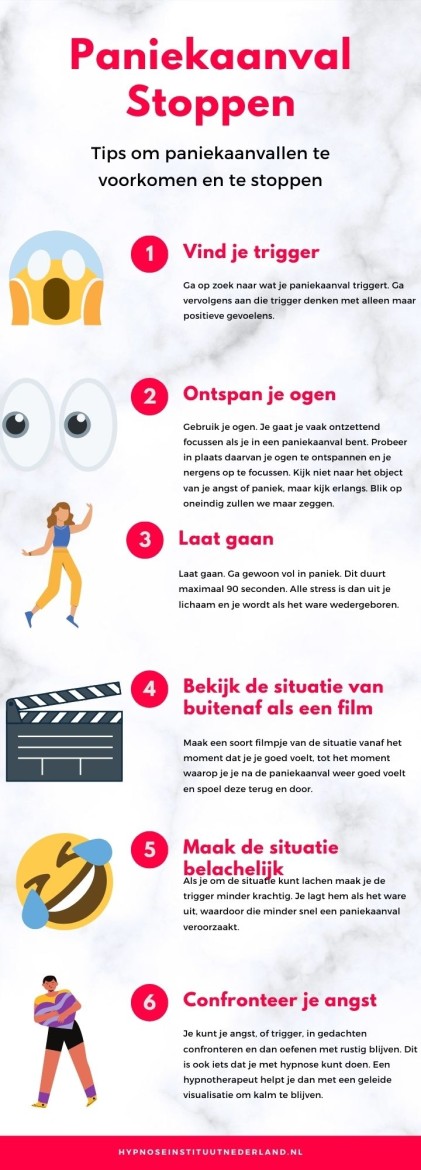
There are a few steps you can take yourself to prevent a panic attack.
Step 1:
Start looking for what triggers your panic attack. Then start thinking about that trigger with only positive feelings.
Step 2:
Use your eyes. You often become incredibly focused when you are in a panic attack. Instead, try relaxing your eyes and not focusing on anything. Instead of looking at the object of your anxiety or panic, look past it. Eyes on infinity shall we say.
This sends signals to your brain that you need not be afraid and can relax.
Step 3:
Let go. Just go full panic mode. This takes a maximum of 90 seconds. All the stress is then out of your body and you are reborn, so to speak.
Fast phobia cure
In addition, then, you can use hypnosis to eliminate your anxiety or triggers in advance. One way to do this is with the fast phobia cure[3]. The people who invented NLP interviewed people who had an anxiety and now no longer suffered from it. This is to investigate how to get rid of a fear.
It showed that people who had solved it for themselves that they saw themselves panicking, for example, in an elevator, and they thought to themselves that it was "ridiculous." Then they shot into laughter. So they laughed at themselves.
Others said, "Suddenly it seemed like it was very far away. Like it was no longer relevant."
This inspired them to use a few techniques. Namely, that people were encouraged to watch themselves go into an elevator and then smile.
This doesn't always work right away, but in the people for whom it did work, anxiety became less. So this idea was developed further. From this, the fast phobia technique was developed. In the training a whole day is spent learning this technique.
Briefly, you create a video of the situation in your mind. Before the situation you felt fine and after the situation you feel fine. So your good feeling surrounds the feeling of fear.
Then you rewind that video. You start at the end and rewind it back to the beginning in your mind. Since you've never done that before, this seems to neutralize the fear. You can also make the video black and white, as if it were an old photograph. Then it is an old movie that you rewind. And then with a funny music added to it, making you laugh.
So we have black and white, rewind and laughter included. After doing this 3 or 4 times you can test how you feel then when you think about your trigger. For example, grade it first.
Repeat until the number is low enough for you, until you feel fine.
Are you scared right now and can't imagine it ever going away? Then visualize what your life would be like when it's over and make that part of the video. If you're in the middle of a particular fear right now, you can imagine what it was like before and also what it will be like when it's all over again.
You can repeat this too, which will make you feel a lot better at some point.
This seems very simple, but it's super effective. Still want to know more about this? Then sign up for the training.
Confront your fear
In addition, you can also use confrontation with your fear. This technique is also commonly used by psychologists. The nice thing is that both techniques work just as well[4]. This has also been tested with an audio recording of counseling from a fast phobia cure, so you can see what happens when applied specifically to you.
You can also confront your fear in hypnosis. Then, during a guided visualization, you learn how you can also stay calm in a tense situation in order to prevent a panic attack. Personally, I do find this technique more boring to go through with people and it also evokes feelings of anxiety more often than people who are given the fast phobia technique.
Want to learn more about hypnosis and how you can use it to help yourself or others? Then come to a hypnosis playshop. The playshops are held in Wormerveer and Zwolle.
Want to see demonstrations, for example, of the fast phobia cure? Then come to a hypnosis seminar. These are also given online.
Instead, would you like to learn how you can use the fast phobia cure and other techniques to help people, for example as a coach or psychologist? Then sign up for one of our training courses. The trainings are also given online from a professional studio.
Also pin this helpful infographic
Sources:
[1] https://www.rivierduinen.nl/uw-hulpvraag-ons-zorgaanbod/Angstklachten/Angststoornis/Feiten%20en%20cijfers#:~:text=Angststoornis-,Feiten%20en%20cijfers,van%20een%20paniekstoornis%20als%20mannen.
[2] https://www.mayoclinic.org/diseases-conditions/panic-attacks/symptoms-causes/syc-20376021
[3] https://web.a.ebscohost.com/abstract?direct=true&profile=ehost&scope=site&authtype=crawler&jrnl=13511297&AN=19778911&h=cDIHqEyz4y1N%2fcoXRoTBFymRjsLNCVddr5UI%2fVibp62D0EvlDVWfKnjzRBiLEN9S0KnOI%2fvT8VWt%2bhbbT9VUkw%3d%3d&crl=c&resultNs=AdminWebAuth&resultLocal=ErrCrlNotAuth&crlhashurl=login.aspx%3fdirect%3dtrue%26profile%3dehost%26scope%3dsite%26authtype%3dcrawler%26jrnl%3d13511297%26AN%3d19778911



