An interesting phenomenon discovered by Edward L. Thorndike (1874-1949) is the phenomenon, operant conditioning, but what is it?
Operant Conditioning
According to Thorndike, man will do anything to become lord and master of a new situation. He does so, when he has no other frame of reference left, by trial and error. So he experiments and from his mistakes he learns.
What is the major difference with classical conditioning is that a stimulus is not used on purpose, but the behavior happens spontaneously on a stimulus. So instead of training reflexes into it on purpose as with the dogs and the bell, operant conditioning trains reflexes that happen spontaneously.
For example, a baby cries at night and the parents' reflex is to comfort, feed or take him to bed with them. These reflexes happen spontaneously and are conditioned that way.
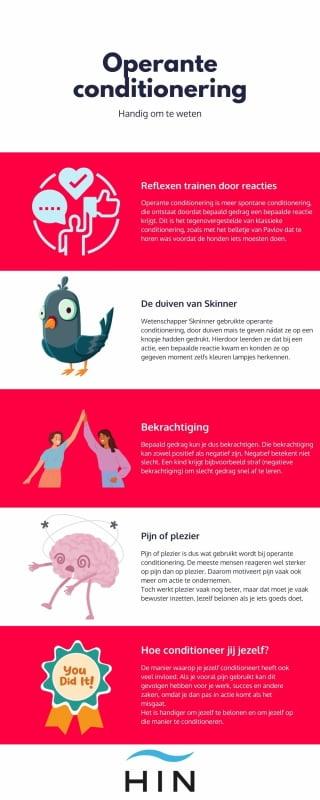
Skinner and his doves
 The most famous experiment in this is that of Skinner and his pigeons. When you put a hungry pigeon in a cage it will do anything. He put a button in that cage and when the pigeon pecked that button then a kernel of corn would come out. That's how the pigeon learned to peck on the button.
At one point, he also put a light there and the corn kernel came only when the light was on. At some point, the pigeon caught on to that and pecked the button only when the light was on.
He even put in two lights and two buttons, one green and one red. That way, he even taughtthe pigeon to press two different buttons that went with the lights.
In operant conditioning, then, picking the button is called the "response," the corn kernel a "reinforcer," also called the consequence. And the light bulb is the discriminative stimulus. Discriminative means that in the presence of a certain stimulus (for example, the light bulb) certain behavior (the pecking on the button) is reinforced and others do not happen.
Empowerment and Reward
There can be empowerment in a variety of ways, both positive and negative. Not only that, a punishment can follow that is both positive and negative. Indeed, if no consequence follows then that behavior extinguishes, so to speak, and nothing will happen. If the pigeon is no longer given a kernel of corn at any given time, then it is not going to peck at the button either.
Positive reinforcement is administering a desired stimulus (e.g., the corn kernel). Negative reinforcement is the removal of something unwanted, for example, the teacher has punished a child by wanting him to stay after, but then the child tries very hard. If the teacher then says he will not do the punishment this time then that is negative reinforcement. So negative is not necessarily negative but means as much as not doing something.
Positive punishment is the administration of a negative reinforcer, negative punishment is the removal of a positive reinforcer. Punishment occurs everywhere and causes behavior to decrease. That is the purpose of punishment.
Pain or Pleasure
When we then look at the reinforcers, so to speak, you can get roughly 2 different responses, pain or pleasure. Either reward or punishment. Either you are rewarded for your behavior or you are punished for your behavior and that is how you condition new reflexes.
Now almost everyone knows that rewarding for good behavior works best. Yet most people are still most motivated by pain, or wanting to avoid pain.
Just think...
Have you ever been in a relationship that went out?
Why did it go out?
Because you wanted to have more fun without a relationship?
Or that it hurt so much that it was better to break up.
You also see it a lot with people who are overweight. Then when they are really too fat for themselves or the chair sticks when they get up, it's time to go to that gym. Then when they feel a little better again and the chair doesn't honor staying stuck, they lose motivation. They don't really enjoy it so they don't keep it up.
This is true with many things.
Pain is a very good motivator but people do exactly that which avoids that pain and no more. The first animals in which this phenomenon failed was in dolphins. When those were punished for not doing something, they simply swam away and did nothing more at all. Whereas in other animals this worked.
The moment they started rewarding it worked. Then they started using it with other animals and found out that it worked much better anyway. Now that seems like an open door, but do you reward more than you punish? With your children?
With yourself?
How do you condition yourself?
Most people punish themselves all the time, creating all kinds of problems. They condition themselves in such a way that they can even become afraid of making mistakes. When that happens then you really have a problem. After all, that is the heart of learning new things.
Making mistakes is essential. Trial-and-error ensures that you know exactly what to do, but if at some point you don't dare to do it anymore because you keep punishing yourself then it becomes very difficult.
Hence, you need to start rewarding people more for good behavior. We are also animals and quite intelligent animals, although you wouldn't always say so. We do more when we are rewarded and therefore find it becoming more fun than when it is just avoiding pain. That does work, but only for a while.
Yes, I do need to make more money now because I can't pay the bills (pain). Fortunately I can pay the bills again so I don't have to do anything now for now.....
And so it goes on and on, and most people don't understand that it's because of operant conditioning. We have conditioned ourselves that way and a lot of it is hereditary behavior in there as well. If our parents reacted very extremely to anger and it was not tolerated, chances are you have the same.
Families in which violence occurs there the children are more likely to engage in violence as well. The same goes for abuse, depression, anxiety, compulsion and you name it. We copy our parents to a large extent and of course it is all not so black and white, we do imitate them. In addition, we also inherited our genes from them.
What do the genes in this story do?
In fact, our genes explain about 40% of susceptibility to anxiety and depression. The environment explains the other 60%. That's according to research by Christel Middeldorp, who looked among twins at the influence of heredity, environment and personality.
There she discovered that when people are more neurotic and less extroverted they are more prone to anxiety and depression. Serious events can compound this but the reverse also seems to be true according to Middeldorp. People with anxiety and depression are also more likely to experience serious events.
And that's an interesting fact I think. So there seems to be a reciprocal relationship between the two. So when you are anxious and depressed you also get more serious situations on your plate on average. On the one hand this makes sense when you look at the RAS, the reticular activation system. It makes you perceive what you subconsciously want to perceive.
So condole yourself with positive feelings and you'll start experiencing nicer things too 🙂 .
If you think this is a cool article, please give it a like or a tweet 😉
Also pin this handy infographic: