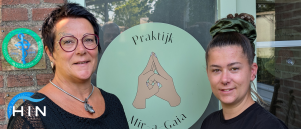
Some people change not because they discover "something new," but because they slowly return to what they have always known. With Miranda van der Endt, it feels exactly that way. She is a psychologist by origin, spent years working in healthcare, HRM and leadership roles, and has been self-employed as a career consultant, trainer and talent coach since 2007. So she didn't "just" start a practice.
She has built a career, stacked knowledge, worked with people in the moments when things teeter: when in doubt, downtime, loss, grief, or that nagging feeling that your potential is somewhere inside ... but not quite coming out.
And yet Miranda says now, "I am in a year of change."
Not because she's fed up with it all, but because she feels it's time to bring together everything she can do (coaching, career, psychology, attachment work, hypnotherapy and everything she's learned along the way) into something that makes sense. Something that not only works for clients, but also for her: lighter, clearer, with more balance.
And most importantly, with an explicit focus on women.
Hypnotherapy remains open to all with her. But her coaching, workshops and the movement she wants to build, from now on she deliberately focuses on women. Not out of exclusion, but out of urgency: because she sees too much female potential that remains untapped. And because she believes that we as a society, men and women, have something to gain there.
From shuffling paper to helping people
Miranda's route starts classic yet recognizable: psychology studies, specialization in work and organizational psychology, work in healthcare, HRM/staffing, advancement to managerial positions. She also took a management course. On paper, that's a solid path.
But at some point came the question that tilted everything: "Why did I study psychology in the first place?"
Not to "shuffle papers away," she says. "But to help people. To really stand beside people at tipping points."
That became the start of her work as a career and talent coach. She became self-employed because she wanted to do what she loved, and because she loves empowering people.
Miranda sees talent as something unique that is in everyone, but doesn't always become visible. Sometimes because someone doesn't dare. Sometimes because someone keeps themselves small. Sometimes because life rumbles over them with expectations, roles, agendas and obligations.
For a time, she also worked specifically as a coach for college-educated women. She loved that, until she felt: again, I've seen this, I want to move on. Not because it wasn't valuable, but because she noticed that she wanted more tools. Deeper. Faster to the core. Less talking around the core.
And then hypnosis came back into the picture.
The seed planted in school
The beauty of Miranda's story is that hypnosis is not a "marketing trend" for her. It started much earlier. She explains that once in high school she heard that you could help people with hypnosis. That it could be used therapeutically.
And that touched something in her: if it can be done, I want to learn it.
Then what happens to many people happened: life went on. Studies, work, business, clients, busyness. The idea faded into the background.
Until Edwin Selij (as Miranda calls it) "started making quite a fuss." Not because she went to shows or hunted for discounts; she didn't. But because it reminded her of that old idea: oh yes ... hypnosis. I wanted to learn that someday.
She went searching, came across the Hypnosis Institute Netherlands (HIN) website and signed up. At first, even a bit as a hobby: "just checking it out."
But in the meantime, something was changing. In her practice. In her clients. And in herself.
Hypnosis as an additional tool ... which eventually became the main thing
Miranda started hypnosis not because she wanted to sell "something new," but because she had worked for years with people who came with more than a resume question. In career counseling, you encounter trauma. Dismissal can be a grieving process. Illness can cause an identity breakdown: "You didn't just lose your job, you lost a piece of your future."
And that's where hypnotherapy fits perfectly for her: as an additional tool to help people. A way to not only cognitively grasp what is going on, but to reset the system from the inside out: emotions, beliefs, patterns.
What she didn't expect is that hypnotherapy would become so big in her work. Meanwhile, the majority of her clients come for it precisely. Hypnosis became not "an add-on," but a core.
And at the same time, they remained realistic: hypnotherapy is not a game.
Why They Consciously Learned: 1.0, 2.0 and 3.0
Miranda is outspoken about something many therapists think but don't always say out loud: just the basics are not enough.
She took the HIN 1.0 (circa 2019, live), then the 2.0 in corona time (2020, online) and completed the 3.0 in January 2025. She deliberately left time between modules. Not because she had doubts, but because she seriously wanted to integrate it into practice.
And she did more: also basic medical knowledge, because she wanted to be recognized and work professionally. She sought a well-run practice to get extra flying hours, spar with colleagues and learn the craft in depth. Because, she says, "Ultimately, you learn in practice. And yes, serious issues come your way."
That professional attitude marks her: Miranda loves inspiration, but not lightheartedness when it comes to mental health. She's pretty serious, she tells herself, and she takes her profession seriously. People don't come with "a little thing." They come with real issues.
1.0: foundation, but also responsibility
The 1.0 gave her the foundation. But she is also honest: with only 1.0, you have to be careful. Not because it's "bad," but because as a facilitator you have responsibility. You have to know what you are doing, what you can handle, and when to refer or need extra support. That awareness made her want to do more than "learn a technique."
2.0: Growing to a full practice
In the 2.0, she saw opportunities to deepen her work as well as expand her practice. She remembers a moment that stayed with her: "Anneke told me that she had 7 to 12 clients a week. I thought then: that's where I want to go too. "
And it succeeded. She continued to grow. She got to that level and even above.
But later came the next lesson: Just because it can be done, doesn't mean it's right.
3.0: on your own, with balance and direction
For Miranda, the 3.0 did not become "just another training course," but a tipping point. "I started the 3.0 because I noticed that I wasn't helping some people well enough yet. I wanted to get better. Dot the i's. Even more opportunities."
And then something unexpected happened: she began to doubt whether she wanted to continue with hypnotherapy as her main business. Not because she doesn't like it, but because it can be tough.
Hypnotherapy is intense. If you do it right, it requires a lot: attention, energy, bearing.
She says it very honestly: 5 days a week, 4 clients a day, you can't do that. Not if you're serious about it.
Instead of throwing away hypnosis, they discovered something else: hypnosis may become part of a larger program.
She wants to make her work lighter. More playful. More from her broad palette. The 3.0 gave her not only techniques, but more importantly insight: "I'm going to do it my own way now, and I'm going to do what I care about."
That is perhaps the biggest impact of 3.0 on her career: not "being able to do more," but "choosing better."
Studying at HIN: inspiring, but not "just doing it"
Miranda also says very clearly: she did not find studying easy. There is a close look at how you do it. It's not, "get in and can do it for a while." She really had to study for it. Practice. Repeat. Just like playing the piano, she says: you get better because you keep doing it.
At the same time, she found the training days inspiring. "Instead of it taking energy, I often came away from it energized." She appreciates how the trainings are set up, how they are explained, practiced, worked with stories and examples. That suits her: serious work, but with inspiration.
Vesta's fire: why it is now targeting women
Then comes the topic that Miranda visibly goes "on" about. She wrote a book about influential women: The Eternal Fire of Love.
She tells about the Vestal Virgins (high priestesses) who guarded the fire of Vesta for centuries: independent, not married, spiritually and worldly influential. They controlled valuables, were learned, carried responsibility. Autonomous.
"Under the influence of Christianity, temples were closed and everything "pagan" disappeared. The fire went out. And since then, culturally, women have increasingly been pushed out of positions of influence or cast in a suspicious light," Miranda said.
In doing so, she even makes the bold notion: Mary Magdalene and Mary could have essentially been "independent women" as well. Mary was called Virgo in a Latin version, which means virgin, but could also mean young independent woman.
Miranda's point is not that women should "take power." She doesn't want a reverse hierarchy. She wants balance: masculine and feminine attributes as complementary. Coming out together in the middle.
But she sees a pattern that still persists: women putting themselves second. At home "still doing laundry." In groups automatically looking at the man if there is one man among them, as if he were the president. Unconscious patterns, deep in the culture. Not necessarily fault, but reality.
And that touches her, because she sees it time and again in her practice: underutilized potential.
That's why she wants to convert her workshops to women-only groups. She noticed immediately that it does something: women enjoyed working consciously together. It created strength, safety, support. And she also names something sharp: "Men are often more used to helping each other and teaming up, while women can be more quick to be critical among themselves."
She wants to create a movement there: women who do carry, do empower, do help each other stand.
Modest at the center: daring to stand on your own terms
Previously, Miranda taught the workshop "Ignite Your Fire," especially for women. One participant said, "You were so humble at the center." And that touched her.
Because that is exactly what she grants women: "You don't have to make yourself bigger than you are to be allowed to stand. You don't have to suddenly become loud, dominant or "manly." You may be modest and visible. You are allowed to take your place in your own way."
Dare to be yourself," she says. "That is ultimately the strongest."
What Miranda is doing now and what she wants to build
Currently, Miranda works in her practice in Uitgeest (between Alkmaar and Haarlem). She does hypnotherapy, career counseling and coaching. But she is clearly repositioning herself: hypnosis will remain, but not as the only pillar. She wants to combine her broad expertise into pathways in which she gives what is needed.
And its vision for the future is concrete and beautiful:
- Coaching programs and workshops for women, focusing on self-confidence, occupying space, harnessing potential, breaking old patterns.
- Career review (as she calls it): individual and group, with the idea of looking at past, present and future and what keeps you small as well as what calls you.
- And a dream that almost feels like a mini-retreat: a weekend in the country, in a cottage, with hiking in nature. Conversations about where you've come from, what you're up against now, and where you want to go. Processing things, letting go, moving on. Not woolly, but practical and deep. So that you get peace with your unique talents and dare to build your life around them.
The word that keeps coming back is peace: peace with yourself, with your history, with your own way. And then: through. Don't run harder, but choose honestly.
Miranda's mission in one sentence
If you take everything together, her psychology, her career work, her hypnosis experience, her view of women and culture, her own process of "daring to stand modestly." Then this is the bottom line:
Miranda helps women rekindle the fire that is already there so that their talent is no longer on standby.
Not by turning them into someone else. Just by bringing them back to themselves.
Want to know more about Miranda?
View more information about her practice here.
And check out more information on how they help women ignite their fire here.
Want to learn hypnosis just like Miranda?
You can take the training in person or online. Would you like to have a no-obligation chat to see if this is right for you? Schedule a one-on-one consultation here. You won’t be speaking with a salesperson, but with an experienced HIN coach who works with this training program and clients on a daily basis. In 20–30 minutes, you’ll get a clear sense of whether this is the right step for you and which start date suits you best.
The schedule for these sessions fills up quickly around the start of each group. Is there still a time slot available that works for you? Then book it now.