


Meditation is incredibly fine and versatile. Sometimes it is nice to have music on while meditating. Music can enhance and support the relaxing effect of meditation. Especially if you are just starting with meditation, having music on can help you keep your focus and be less distracted. Of course, this is difficult to do with loud rock or house music, but with the right music, meditation is truly relaxing.
To make sure you can get the most out of your meditation, in this article I will discuss the benefits of music in meditation.
Anyone who has ever listened to music has noticed its effect on you. Especially while driving, you may find that a nice rousing song will cause you to get flashed for driving just a little faster than usual.
You may also have noticed that music can move you and literally give you goosebumps through the sounds and talent of the musicians. This is proof that music affects your body that you can observe for yourself with music you like.
Music does not only affect people; animals benefit from it as well. For example, cows give more milk when classical music is played in the barn.
Effects of music on the body
Just as music affects bodily functions of cows, music also affects the human body. This can be observed not only in goosebumps, medics are also interested in the healing effects of music.
Research conducted in 2010(1) shows that patients benefit from music when undergoing surgery or recovering from major surgery. In this study, classical music and opera music were used to test the effect on the body.
Heartbeat
With this music, the heart rate was significantly lower than with music that was somewhat less uplifting compared to more passionate music.
There was no difference in blood flow to the brain compared with rest or when Beethoven's Ninth Symphony was played.
Anxiety
Relaxing music before surgery significantly reduced anxiety in patients and more than medication designed to provide relaxation before surgery, in this case midazolam. Even after surgery, the patients who had heard relaxing music were less anxious than the group who had received sedative medication.
Stress
After surgery, you can also experience a lot of stress from the pain of the wound that now needs to heal. The study also shows that relaxing music has a stress-reducing effect. After 30 minutes of bed rest, the group that had heard relaxing music had less cortisol in their blood than the group that did not have relaxing music included.
Types of music and their effects
In another study on the effect of music on surgical recovery, the best results were achieved with classical music and meditation music. Music with vocals and made with classical instruments had the most effect on cardiovascular signals and heart rate compared to more monotonous music.
Heavy metal and techno had the opposite effect and could even be dangerous after surgery by leading to increased stress and a (life-threatening) irregular heartbeat.
This research clearly shows that music affects the body and mental state, while also showing that not all types of music are suitable for getting rid of stress and maintaining your cardiovascular health.
Therefore, during meditation, it is also best to choose classical music or specially created meditation music. On the free version of Spotifi and on YouTube, you can also turn on focus music that is often also very suitable for meditation.
Zen meditation music
Zen meditation is a form of meditation that focuses on concentration and self-discovery. The idea is that through this focus on yourself, you find out the essence of yourself and your daily doings.
Mostly it comes down to being able to experience emptiness instead of an "I. That you are just there without putting all kinds of values on it.
The daily doings, finding expression in daily life has the goal of living a selfless existence and how to shape it in daily life.
During meditation you can have music in the background, this helps to focus during meditation and to recognize the sensations of changes in consciousness. To be able to explore the stimuli and automatic reactions of the body and that mind.
Soothing music
During meditation, any form, you can use soothing music to better focus on your breathing or the reactions your body and mind have to environmental factors.
If you want to reduce stress with music in meditation, new age music is also often used. A study(2) on calming music compared the effectiveness between new age music and Mozart's Eine Kleine Nachtmusik in terms of effectiveness. A total of three groups participated in which there was a group that listened to Mozart for 28 minutes, a group that listened to new age music for 28 minutes and a group that entertained themselves by reading magazines for 28 minutes.
This study, conducted in 2004, found that people who listened to Mozart had the most sense of inner peace and suffered less from negative emotions. Also, people who had listened to new age music suffered less stress and negative emotions than people who only read magazines for relaxation.
Classical and new age music had the same enhancing effect on feelings of gratitude and love.
So classical music and new age music can be used well to reduce stress and as a background for meditation.
Meditation with music
Research also shows that meditation combined with music can cause tension and depressive symptoms to be significantly reduced.
So meditation and music can be used especially when meditating to reduce stress, against depression and for general relaxation.
Other research does show that the music should fit the goal you have. Special meditation music may therefore, in some cases, work better for your meditation than classical music. Of course, you can try it out for yourself by checking which styles of music work best for you.
Yoga and music
In some yoga traditions, music plays an important role in getting into a state of meditation(3). For example, there are regions in India where it is important to suffer and this is done by piercing. During the piercing process, the person is first put into a trance or meditation in which music and mantras play an important role.
Music and mantras also play an important role in healing ceremonies in yoga traditions. Certain tones are linked to certain chakras in yoga teachings. These elements are still used in modern music therapy in India.
Nada yoga is the yoga form where music matters. In this form, it is first and foremost important to listen to the music of your body. To the sounds your body makes. Next, it is important to listen to actual music. This acoustic music is used during the meditation and Hatha yoga used at Nada yoga.
The music in yoga aims to evoke feelings of comfort, hope and peace, and to reduce pain and anxiety.
For example, music and yoga meditation can be used for anxiety and pain when being treated for cancer.
Alpha music without rhythm can be used to evoke relaxation, but it is also clearly stated that people's own preferences can also guide the music best used during meditation and therapy(4).
In addition, music with a certain rhythm can also support changing asanas or breathing during yoga meditation.
Preferred music of interest
In all this research, much is becoming clear, namely that acoustic music and music without rhythm can help promote meditation and its effects.
In addition, it also becomes clear that the musical preference of the person meditating or receiving music therapy is important to its effect. It is also important that the music fits the situation.
Therefore, the best solution while meditating is to test classical music, meditation music, alpha music and music of your own preference to find out which style of music helps you best to support meditation.
Only heavy metal and techno music I have to advise against based on the research on reducing stress. So that's some bad luck for the headbangers reading this article.
Want to learn more about techniques that promote your mental health? Then stop by a seminar or check out Hypnosis Institute Netherlands' training programs.
Or join the free online master class on hypnosis.
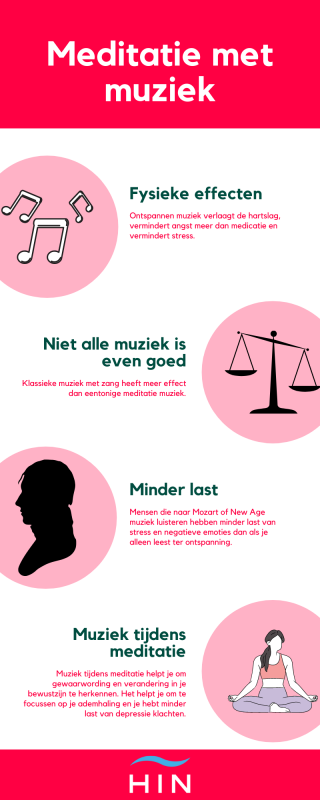
Also pin this handy infographic as a reminder:
Sources:
1. http://heart. bmj.com/content/96/23/1868.short
2. http://jmt. oxfordjournals.org/content/41/3/215.short
3. http://journals. sfu.ca/seemj/index.php/seemj/article/view/77



