


A while ago, during a live session on Instagram, I helped a woman who was afraid of dying, specifically that she would then leave her children behind. This is a fear that many parents have and can also strongly influence their behavior, such as never being on a plane together just in case[1].
More people are afraid of dying, but the fear of how the children will fare is not everyone's cup of tea. A great topic to take a look at how hypnosis can help someone with this fear.
She had suffered from anxiety and panic for many years. Her mother had died 3 years earlier after a distressing illness from cancer. She now also had a small child of five herself and then occasionally suffered from the fear of death and that she would leave her (young) child behind. It was then about the fear of the child's future and that can be treated with hypnosis[2].
Rationally, she understands that she is young, healthy and nothing is wrong, but still, "My thoughts whispering: Yes, you're getting sick, you will die. You see? And then you do get palpitations, and I think see you're having a heart attack."
Reassuring about children's resilience
Of course everyone dies, but that can't be planned for. And these feelings don't help either. So I asked her if she had seen the story of the children who survived the jungle, no.
It involved this story in which four children, the oldest of whom was 13 years old and the youngest only 11 months, had survived 40 days in the jungle after the plane they were in crashed. Three adults, including their mother, did not survive.
I said, "That's how resilient children are. Not normal, but you have to. You see it in disasters, too. I remember at the Christmas tsunami years back. You see a lot of people sitting then. Everything was broken, you see them in shock and a day later they start cleaning up. Immediately the brain goes: Okay what are we going to do? It will be the same with your daughter. Hopefully not for another 40/50 years. People are so resilient, it's incredible."
Research also shows that children have great resilience after a parent dies. A positive but authoritarian way of parenting after the death of a parent can ensure that this does not cause the child problems[3].
The space for anxiety
But her biggest fear was leaving her daughter behind, as she had experienced this herself. Furthermore, she also had no family because she had also had to deal with youth care from the age of 10. Where she had also seen the necessary things. This was because her mother was on drugs, so she did not really have a normal mother-daughter relationship. During the period when her mother had cancer, she was caring for her mother again.
During this time, she also became pregnant which put her in a total care mode. "I have to take care of my child, I have to take care of my mother and then my mother died. That completely fell away, but it wasn't until years later that I collapsed because then everything came up from what I had been through. It was really like Wow, I've never felt this way before. I was never afraid, not of anyone, and now suddenly everything."
That's kind of interesting when you start thinking about it, so I gave her this suggestion: "You had every reason to be afraid from childhood, in the juvenile system, people in the drug scene who aren't great either, so all reasons. The funny thing with fear is that if you "have to," then you switch to survival. Then you switch off the fear. Then we don't. Then suddenly there is nothing to be afraid of and then your brain thinks, Okay now we have the space. And then come all the memories. About all the things that could have happened. But actually you've already spent a lifetime proving otherwise. That you can survive no matter what. So does your little daughter, because she has the same genes as Mom, more or less. Who also has mom's imprint of: We'll be fine. That's just in there. That goes from mother to daughter, that strategy continues. Doesn't matter if she's five, ten or fifty. You made it too."
She agreed.
Of course, it's not always palatable. If you could choose, you would choose a different start to your life. A more relaxed path. But if you have had such a different busier path, you have already learned so much, which you then unconsciously pass on to your children.
The fear and holding a helpful conversation
So what are you afraid of?
She was afraid that her little one then would not see her current girlfriend because she was not well-liked by the father. She herself did not have a good relationship with her child's father either. "But it is still her father. She also goes there every weekend. She has good contact with her father and it's all just good. And then I think: Soon she won't get to see my friend, even though they are four hands in one."
The fear of why her child would no longer see her current girlfriend was in that the father thinks about himself a lot, and on this he is not addressed by his own family. "Yes, and then I start thinking again of: Yes soon this will get totally out of hand and she has to go there. It doesn't make sense in principle."
I was going to change tack for a moment, because that side of the story doesn't help with the agony. It's hard to say about someone you've never seen "Eight girl, your fear doesn't have to be because this guy is a wonderful guy." So then you can't counter that with anything useful. As a hypnotherapist, it is helpful to recognize moments in the conversation when you get stuck and are not helping your client come to a resolution of her fear.
Then you can fall back on other elements of the conversation to still change the mindset about the likelihood of dying.
You are not your mother
So I went back to her mother's story:
"Your mother was obviously someone on drugs. Probably also a heavy life and all that kind of stuff. That may have been what caused her to get sick. Maybe a combination of lifestyle, showered, stress, whole combination.
You are just very different person, you are not like your mother, there let me put it this way. You think, "so, I'm never going to do" you know. Well, so that's already changed, so that chance, the risk, has already changed. Yes, that risk is obviously higher if you obviously just do drugs, drink, smoke, that of everything, the risk of disease goes up. Maybe it takes a little longer if you have good genes. But if you don't have that set, you can have a stroke before you're 40. But anyway, so if you don't do that, that doesn't mean it won't happen, but the risk is significantly reduced. So you've already done that."
She agreed.
No control
I then went on to say that some people, as I subconsciously did, try their best to belong to the club of 27. Musicians who were all super talented, but died at 27. Like Amy Winehouse.
"Needless to say, hey, so I wasn't even afraid of it, somewhere I'd quite like it still. I also didn't ... not really put a whole lot of effort into it, I must also admit. I didn't say, "bomb" it's not like that either. But yes, I, um, I thought it was fine if it had happened ...and then it doesn't happen, so it's also a bit like that...It happens when it happens and you actually have little to no influence on that ...actually."
Should you read this and you have those kinds of tendencies. Call 113, there are people who can give you help.
"When your time is, it's your time. Whether it's 40, 50. Even if you live a healthy life, you can die. The funny thing is, just like kids in the jungle, everyone survives. You survived, too."
The influence you have on your child
You can also imagine that it is more convenient to live in the here-and-now. Her infant daughter was five. Then she is still in the middle of the period when children are pretty much always in a hypnotic state. Until the age of seven, as a parent, you have tremendous influence on your children and can leave an impression.
So I gave her the suggestion:
"You can think of, my little daughter has her own life. All I have to do then is give her positive suggestions and make myself feel good and confident of: "Well, I made it." She has, basically, better circumstances. Her mother who has a girlfriend and ... between you guys going well ... that's already a much better example than your father and mother ... yes, then you already have that ... Well, then that father ... Okay, it's a separate one, but well ... it's not necessarily unsafe, is it? A little bit separate, maybe, but okay so ... Well, so that goes too. She has a good contact with that, she feels good with that, well, actually also top, right? So, so actually, top... Yeah, sure, we from a distance, can think, "Oh yeah, can't we do this differently or see it differently or something," but she's five, you know. She just wants but she loves her father, she loves her mother, and if they're doing well, she's doing well. That's kind of now that stage of life, you know: my mom happy, me happy too."
I then went on to say that everyone eventually figures out that their parents are just people too, with their own problems doing their best. That the woman I helped had figured this out a little earlier than most other people, but that she could already envision herself doing better than her mother.
I asked her how the problem felt to her now, and she indicated that everything is actually much simpler than how it is in her head. That she makes it harder on herself than it is with all her thoughts.
And that was so, because judging by the cards she had been dealt in life, she was really doing quite well as far as I could tell. She just has a girl, little daughter, who is feeling good in spite of everything.
Of course, you can always say you can do better, and you can strive for that, that may be a good thing to do, but sometimes you also need to consider that you have earned a pat on the back. Sometimes it's good to just pat yourself on the back.
When I checked again how she now felt about the fear of dying and leaving her daughter behind, she actually didn't feel much about it anymore. The fear was totally gone and she was confident that her little daughter would manage.
Watch the session here:
Would you also like to help people with hypnotherapy? Then come to the free online master class for an introduction.
Or register for one of our seminars or trainings.
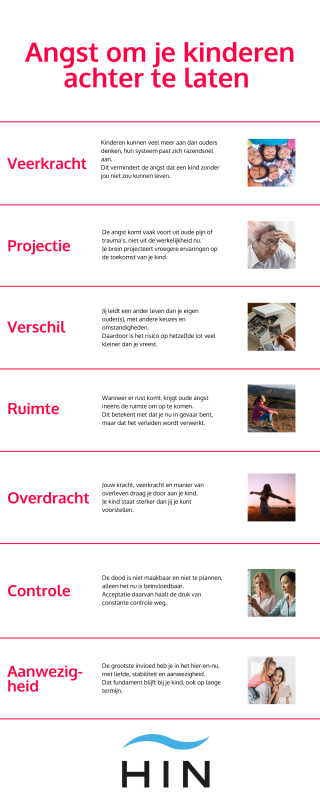
Pin this handy infographic for a reminder:
Sources: