
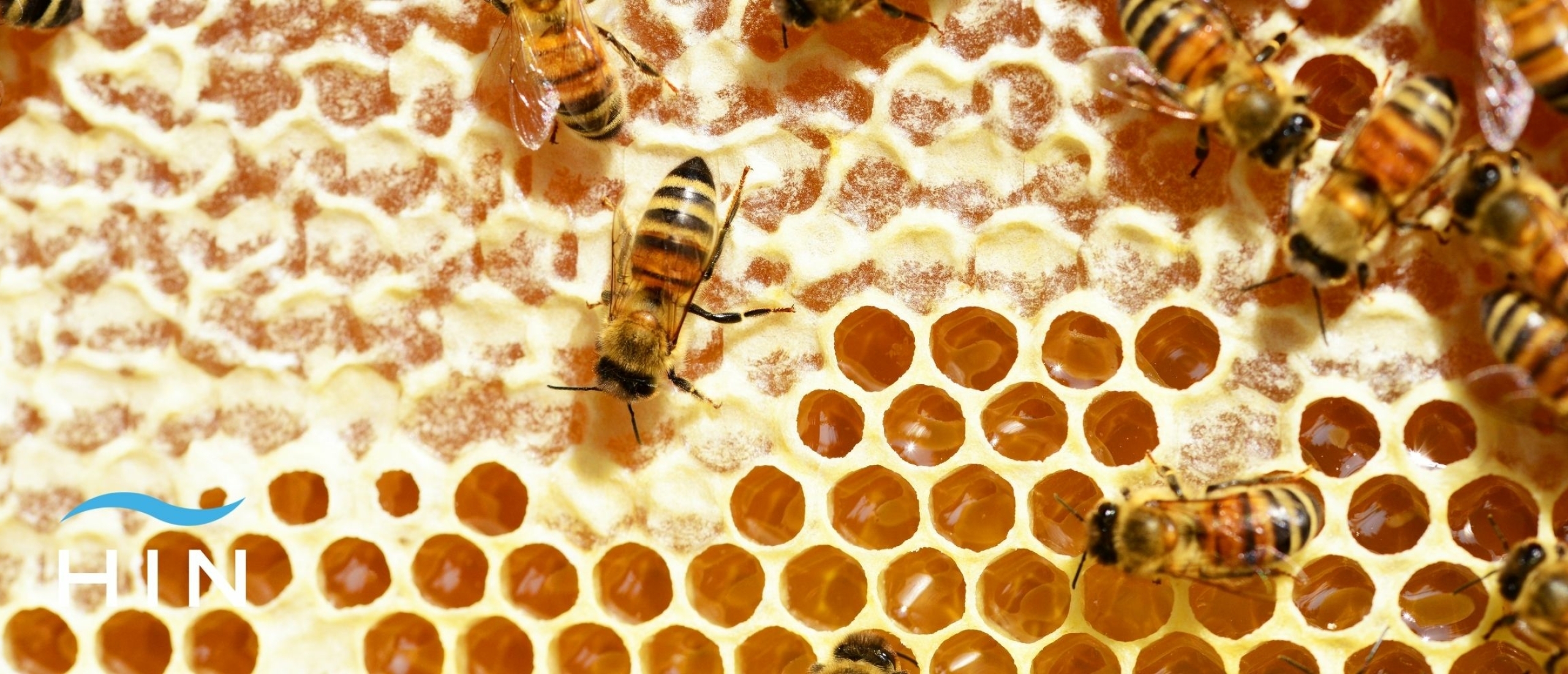

A gross sponge is just a sponge, but if you suffer from trypophobia, that sponge can be something terrible, because it has holes in it. You know, one of those sponges you use to wash your car. If you suffer from this fear, you may also suffer from depressive symptoms and general anxiety disorder, and you may even die earlier.
This fear is also not really typical in terms of your fear response, as you generally feel mostly disgust when confronted with holes that are close together or other geometric shapes that form some kind of package[1]. This disgust or fear can be so great that it affects your daily life.
Is trypophobia real?
If you do not suffer from trypophobia, it can be hard to imagine anyone suffering from it, but it is certainly true. For example, you may get the disgust or fear response of:
- Honey Degrees
- Lots of bells and whistles together
- From those videos where dogs are rid of certain worms
- A group of trees lying cut down on top of each other
- Objects with small holes.
But scientists also question whether this fear is real. The idea is that you have some kind of unconscious natural fear of these kinds of holes, because you instinctively associate it with poisonous animals. They have tested this, but it is mainly the images (of hands with holes in them, for example) and not the poisonous animals that small children, for example, are afraid of. Because of this, some scientists think you can't really call it a fear[2].
In addition, this leads researchers to believe that this fear of cavities is learned behavior[3]. And that's good news, because what you once learned can be unlearned.
But since there is a lot of research on it, you can call this a real fear. So as far as I'm concerned, you can call trypophobia real.
At least it's real for those who suffer from it.
Other researchers indicate that this fear can also be a signal that you are paying very close attention to indications of the presence of parasites and infectious diseases. Most people do have a healthy fear of parasites and infectious diseases, but people with trypophobia thus also get this fear response from safe objects such as a bee sting or the like[4].
People with this anxiety are also often more focused on their own feelings of fear and discomfort and would like to reduce it.
In addition, people with this anxiety are also more likely to experience visual discomfort[5].
Recognizing trypophobia
So if you have trypophobia, you have some kind of fear or disgust of cavities. If you google on this fear you often get to see hands and feet full of cavities. Everyone actually gets nauseated by that, because it has to do with your natural fear of parasites.
It's only a problem if, for example, you're also disgusted by sponges with big holes in them, the bubbles in your coffee and clusters like that that don't really matter at all.
Finding this artwork scary can also be an indication of trypophobia: https://9gag.com/gag/amg8784
You then often feel:
- Abdominal Pain.
- Nausea.
- Cold sweat.
- Trilly.
- Accelerated Breathing.
- Avoiding places or images with visible holes.
And that kind of features anxiety.
Especially that fear of everyday things can wreak havoc on your life. Just make a cup of coffee for someone when you get nauseous from the bubbles.
Treating Trypophobia
Many people with this anxiety do not seek treatment, which is a shame, because it can certainly be treated, although there is no official treatment for it.
But there are many things you can do and many treatments that do focus on it.
Initially, for example, you can learn about anxiety. For example, the knowledge that this fear is seen as something that is learned can already be very liberating.
That it addresses disgust in addition to fear also says a lot about why your body reacts the way it does.
But even then, you'd rather not have to deal with those physical reactions, and then you can look into cognitive behavioral therapy.
For example, cognitive behavioral therapy (CBT) with hypnosis.
In a case study where a seventeen-year-old girl had been suffering from this anxiety for five years and to the point that she could no longer function normally at home and at school, cognitive behavioral therapy helped[6].
She initially learned relaxation techniques to counteract her body's anxiety response, such as progressive muscle relaxation. You can also do this with a mindfulness body scan.
She also gained insight into anxiety, behavior and how trypophobia actually works and why it is an unreal fear.
During the treatment, she was repeatedly exposed to pictures with holes to see how the treatment worked, and a voluntary confrontation with your fear is always helpful in treating anxiety.
Over time, anxiety became less and less.
Other research shows that CBT combined with hypnosis enhances treatment[7].
Treating trypophobia with hypnosis
You can perform all CBT techniques on a client while they are under hypnosis.
In addition, hypnosis also allows you to apply typical hypnotherapy techniques. This too can be enough to overcome anxiety.
In fact, research shows that using hypnosis against anxiety can reduce symptoms by about half after just two sessions[8]. This is because with hypnosis you reach the subconscious. That subconscious is then re-learned something, so to speak, which can then replace the fear of cavities, this changes you so that you suffer less psychologically and physically from the fear.
But what happens in those sessions?
Generally, an exploration session takes place first in which you talk a bit about your life and how your trypophobia affects that life. Also, you can already address a bit about where you think the fear comes from.
Depending on this conversation, the hypnotherapist chooses a technique to overcome the fear.
Confronting fear
Anxiety is often thought of as confronting fear in order to overcome it.
Confrontation with fear, for example, can also be performed while in hypnosis. In that case, you can receive a guided visualization from a hypnotherapist in which you combine techniques for staying calm with a confrontation for your fear of cavities.
After performing this technique, the therapist performs a checkup on you to see if the anxiety is already "gone." If yes, you have succeeded. If no, then further work is done.
The source of trypophobia
Another technique is regression. With regression, you go back to the first moment when you felt the fear of cavities and when it began to affect your life. Then you start doing something in your mind with that moment to look at that memory again, for example. This helps you to verify that you drew the right conclusion as a result.
Sometimes it can be enough to empathize with other people who were present at the time, such as someone who may have had a skin problem or who also had a fear of cavities.
This can help you see that there's actually nothing wrong when you see a pothole once. The hypnotherapist helps you empathize with other people.
Sometimes it takes more than just empathizing with the situation or just looking at it differently. In that case, you can change the situation in your mind. For example, you can have your present self talk to your younger self about the impact of that moment and that the moment is really over anyway and that you may let go of the trypophobia.
Trypophobia, then, is a fear of cavities that is linked to your survival mechanism, but becomes unreal as long as it has nothing to do with diseases. Like when you can't look at a Bros.
In that case, delving into anxiety, CBT and hypnosis can help you overcome it.
Want to learn more about how hypnosis can help people overcome fears, such as the fear of cavities? Then come to the free online master class on hypnosis.
Or enroll directly in one of The HIN's training courses. The trainings are conducted online from a professional studio and with enough professionals for one-on-one attention. This way, nothing can get in the way of the flow of your training.
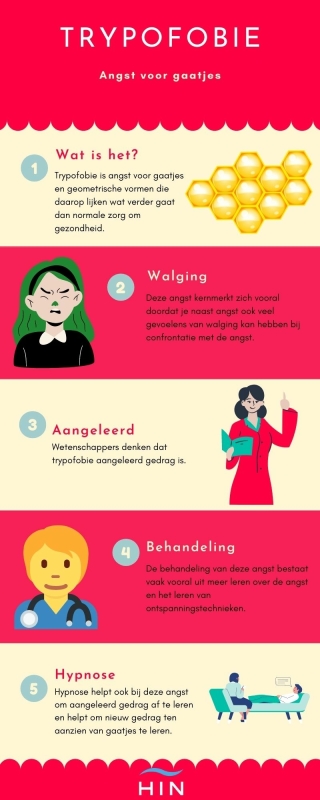
Pin this infographic as a reminder:
Sources:
[6] https://www.proquest.com/openview/02c08bbfe1c2dcd490e6f8c6bdd69dd5/1?pq-origsite=gscholar&cbl=28708



