
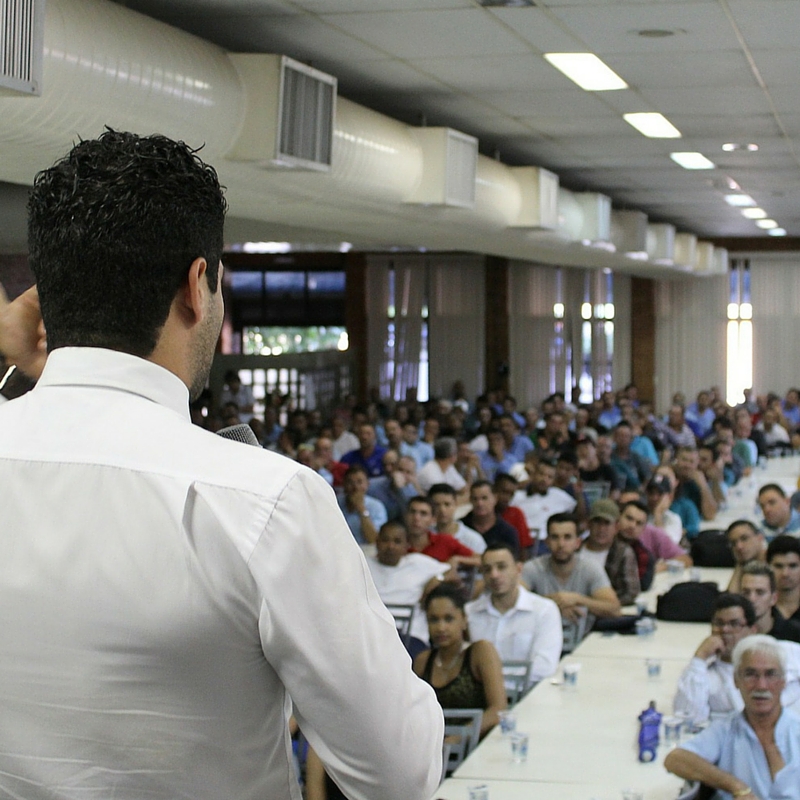

Sometimes people accuse you of being introverted. Always quiet, but that's actually not what bothers you at all. You want to say all kinds of things. You really do have something to say, but somehow that's something you don't dare to do. Maybe you are afraid that what you have to say is not relevant which makes you look stupid, but if you were stupid you probably wouldn't have been in the meeting already. Saying precisely nothing can create a false image about your commitment to the organization that the meeting supports.
In this way, speaking anxiety can get in your way tremendously during everyday life. Speaking is important in almost every industry. Not only teachers often have to stand in front of a group, other professionals are often asked to give a presentation, even in professions where you don't always expect it. Therefore, in this article, I will discuss what speaking anxiety is and how to overcome your speaking anxiety.
Speaking Anxiety
Fear of speaking is the fear of speaking in public places. For example, you may be afraid to give a presentation or afraid to give your own input at a meeting. Some people also find it scary to walk down the street because they may be addressed by a stranger, such as someone asking you for directions. Symptoms of speech anxiety include:
- Intense anxiety before or during group speaking.
- Avoiding situations involving speaking in front of a group.
- Physical stress, nausea and panic attacks in the conditions mentioned above.
You get the physical reaction through your body's fight, flight or freeze response in the stressful situation of speaking in front of a group. That stress reaction can also cause you to stutter or have other problems speaking.
At that point, this exacerbates the stress response that the body gives off.
Fortunately, you're not the only one who suffers from speaking anxiety to some degree. In fact, research shows that 75% of people, that's 3 out of 4, do find it exciting to say something to a group. Yet it is only a small percentage that let that fear affect them to the point where they really suffer from their speech anxiety.
After all, what are we all so afraid of? What can happen to us?
Initially, you get fears about what others think about you, such as that you are weak or an idiot. You fear that if you show your fear you will fall through and be rejected.
Speaking anxiety and survival
The fear lies in man's survival instinct. After all, we are social animals. Our ancestors could only survive by working together. So falling outside the group due to behavior could be deadly.
But that is a time we have already passed. Saying something wrong once does not immediately mean that you will be dropped in the jungle and have to manage among the monkeys and tigers. Certainly in the Netherlands you can't get hurt if you say something wrong as far as survival is concerned, compared to the times when the saber-toothed tiger was our greatest enemy. Fears are based on instincts that no longer apply in today's society.
Overcoming speaking anxiety tips
This is precisely why it is so important to overcome your fear of speaking. First, there is nothing to be anxious about, and second, you can live a better life by overcoming your fear of speaking. You may find out that what you have to say is very interesting to the group and is actually well responded to. In fact, overcoming your fear of speaking will give you an edge over 75% of your peers who keep their mouths shut [1].
Therefore, I have a few self-hypnosis tips to help you reduce your speaking anxiety.
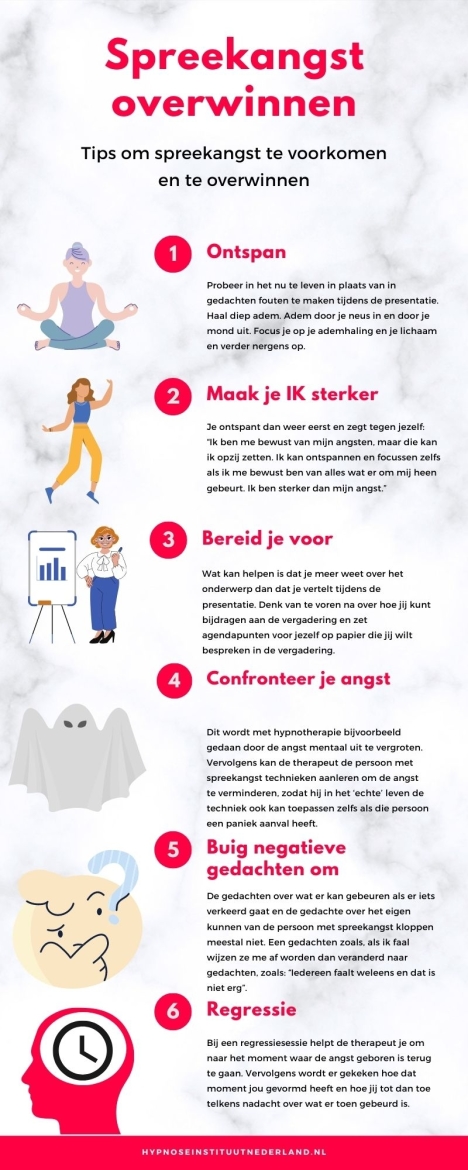
Relax
Before hypnosis and also before a presentation, it is important to relax. Try to live in the now for a moment instead of making mistakes in your mind during the presentation. Take deep breaths. Breathe in through your nose and out through your mouth. Feel the weight of your body and the contact you make with the floor you are standing on or the chair you are sitting in. Focus on your breathing and your body and nothing else.
Through this relaxation exercise, you will get rid of physical stress symptoms. You will find that you are in control of your body instead of your body being in control of you.
Making your I stronger
Through the relaxation exercise, you already notice that your fears can be set aside faster than you thought. During self-hypnosis, you also relax. You lie down on your bed or sit in a comfortable chair. You then relax again first and say to yourself:
"I am aware of my fears, but I can put them aside. I can relax and focus even when I am aware of everything going on around me. I am stronger than my fear."
Should you have a panic attack during a social moment. Just relax by taking a deep breath and repeat to yourself in your mind:
"I am aware of my fears, but I put them aside now. I have better things to do than be afraid.".
Speaking anxiety before a presentation and meeting
To reduce speaking anxiety before a presentation, you can use all of the above tips as well. Especially relaxing before the presentation and during the presentation when it gets too much for a moment can help you. If you panic during the presentation, take two good breaths in and out. Then when you look at the group pay attention only to people who smile or nod at you and ignore the rest.
Proper preparation
Before a presentation, you can reduce speaking anxiety through proper preparation. What can help is knowing more about the topic than you are telling during the presentation. This also reduces your anxiety about the questions after the presentation because you really know everything about the topic.
Put a checklist on paper
Before a meeting, you usually get an invitation that includes the purpose of the meeting. Think in advance about how you can contribute to the meeting and write down for yourself items you want to discuss in the meeting. Then use the aforementioned techniques to stay calm during the meeting to make your points as well as possible.
Also listen to this podcast:
Speaking Anxiety Hypnotherapy
There are all kinds of therapy for speech anxiety. Research does show that when hypnosis is applied during therapy through relaxation exercises it works better than "normal" cognitive behavioral therapy. Treatments arrive better if the person with speech anxiety is first in hypnosis before treatment begins(1).
For speech anxiety, 1 or 2 hypnosis treatments are usually enough. A hypnotherapist can use the following techniques to reduce speech anxiety.
Confronting fear
There are two types of confrontations with fear a literal confrontation and a mental confrontation. In the case of a hypnosis session, the hypnotherapist will make you confront your own fear. This is then done, for example, by mentally magnifying the fear. Then the therapist can teach the person with speech anxiety techniques to reduce the fear, so that in "real" life he can apply the technique even if that person has a panic attack.
Reversing negative thoughts
Especially with speaking anxiety, the fear consists mainly of preconceived notions of the person. The thoughts about what might happen if something goes wrong and the thought about the person with speech anxiety's own ability are usually not correct.
The previously mentioned thoughts such as, if I fail they reject me are then changed to thoughts such as: "Everyone fails sometimes and that's not a bad thing."
Regression
Fear of public speaking must have come from somewhere at some point. In a regression session, the therapist helps you go back to the moment where the fear was born. Then they look at how that moment shaped you and how you thought about what happened at that time each time until then.
It then looks at the event from a different perspective so you can give new thoughts to that moment. Through this technique alone, speaking anxiety can be removed entirely or reduced to the point where the fear of speaking is reduced to the level of a person who can handle it normally.
Speaking anxiety in students
In education, students usually develop speaking anxiety. Therefore, prevention and timely intervention in the development of speech anxiety is very important. Are you a teacher or do you guide students and pupils in other ways and would you like to use hypnosis to reduce speaking anxiety in students? Then you can follow a training course on hypnosis at the Hypnosis Institute Netherlands.
Want to know more about hypnosis and learn useful trics and tools? Then come to the free online master class on hypnosis.
Or enroll in one of our training courses.
Also pin this handy infographic:
Sources:
Integrative CBT for Anxiety Disorders, Alladin, 2015.