
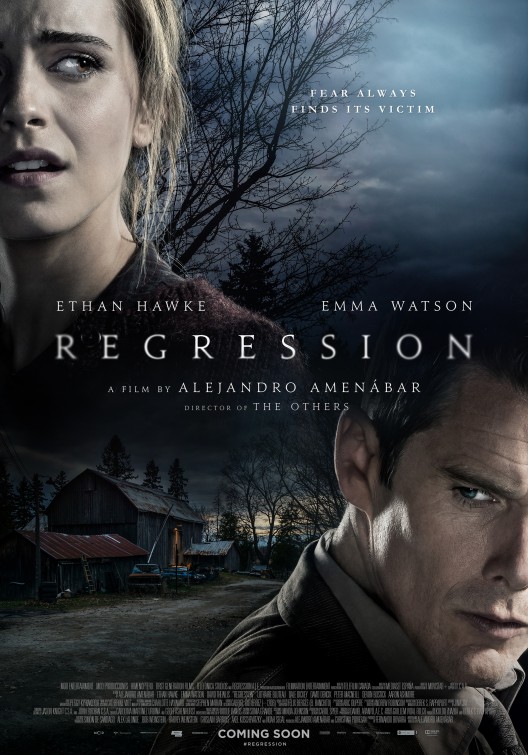

Yesterday I watched the film Regression with the team. We were invited to watch the movie due to the fact that the movie is about hypnosis. But is it true?
Regression
The film is based on true events, which makes it interesting. The main characters are Ethan Hawke and Emma Watson (from the Harry Potter films).
Angela (Emma Watson) was abused by her father and fled to the church. Her father remembers nothing about it but has confessed. He can't imagine it but he also can't imagine his daughter lying so someone is brought in to hypnotize him.
In hypnosis, he remembers the incident again, but also that several people were present with black hoods. It was a satanic ritual he was involved in and dragged his daughter into.
Hypnosis and guiding questions
The moment the professor brought the father into hypnosis, I noticed something. He asked a lot of leading questions, and that creates problems when you start working with regression. In fact, the first time the father went into hypnosis and saw a room and there also a man in that room hanging over his daughter.
He says that's me in that room and the professor said "No that can't be, that's someone else, look closely...
At that point, the professor gives a suggestion that it would be someone else, creating a false memory. A variety of other suggestions were also added at one point, giving the film a bizarre and horror-like twist.
False memories
In the 1980s and 1990s, many men were innocently incarcerated for performing regression incorrectly. Because you can very easily create false memories in hypnosis, it is imperative that you do not ask leading questions. If you don't, then there is nothing wrong and you can do regression just fine.
If you do, you create false memories that can cause the client to believe things that never happened at all. And you saw it happen with the hypnosis that was performed all the time. Lots of leading questions and suggestive questioning that were used to create memories.
That was very freaky to see and especially since it involved satanic rituals where babies were sacrificed. Imagine if your hypnotherapist started asking such questions in a state where you could very easily confuse fantasy and truth.
Regression works very well
Personally, I'm a big proponent of regression because it makes it easier to get to situations that are often the foundation for the behavior you have now. This movie underlines very well that you have to have a very thorough education to be able to do this. That is why we have a regression form in the basic training that is completely content-free. That way you can't create anything crazy.
Only in the advanced training do we start working a little more with content but make sure there are no leading questions involved. You can see how important that is in the film.
All in all, I thought it was a good film that shows well that you really do have to watch out with regression. I also think that is a valid conclusion. However, the conclusion they immediately draw that it would not work well because of that, I disagree.
You can also see in the film that it works fine, just the wrong way. However, that's because of the professor's questioning of it badly. If you know that, then of course you don't do that and don't ask leading questions.
An interesting experiment further demonstrated this effect very strongly.
Laurence and Parry (1983) asked people under hypnosis:
"Was there something that woke you up at 4 a.m. this morning?
Most of the time, they then said "Yes.
Then they asked "Was the sound suddenly there?
And again, they then said "Yes.
When they were then interviewed out of hypnosis a few days afterward they all said they had suddenly woken up to a sound. When they were then told it was a false memory, some just got angry. That's quite extraordinary, don't you think?
Reconsolidation
Anyway, this doesn't just happen in hypnosis, it also happens in everyday life. After all, we don't perceive everything and we don't store everything. Maybe unconsciously but consciously we don't remember a lot of things.
Indeed, when you recall a memory now it is changeable at that moment and we store it again. That effect is called reconsolidation. It means that you can change that memory and then store it again. Then when you remember it again, you don't remember the "old" memory, you remember the "new" one. You always do.
So essentially, you yourself are creating false memories all the time, and probably all your memories are, let's say, not entirely truthful. That's ok, especially when you feel good about it.
The big difference with hypnosis is that that process is a bit faster and amplified, but it is and always will be a natural phenomenon. It has nothing to do with hypnosis per se. We already do it.
If you want to go see the movie, it premieres Nov. 12 and it does give a good idea of what hypnosis can accomplish in people.
And also that you have to watch out with leading questions because in this case it does turn out to be quite freaky....
Feel free to share or leave a comment 🙂




Joop Fenstra
on Nov 10, 2015Chila
on Nov 10, 2015Malika van Bekkum
on Nov 10, 2015Anneke Hooijer
on Nov 11, 2015