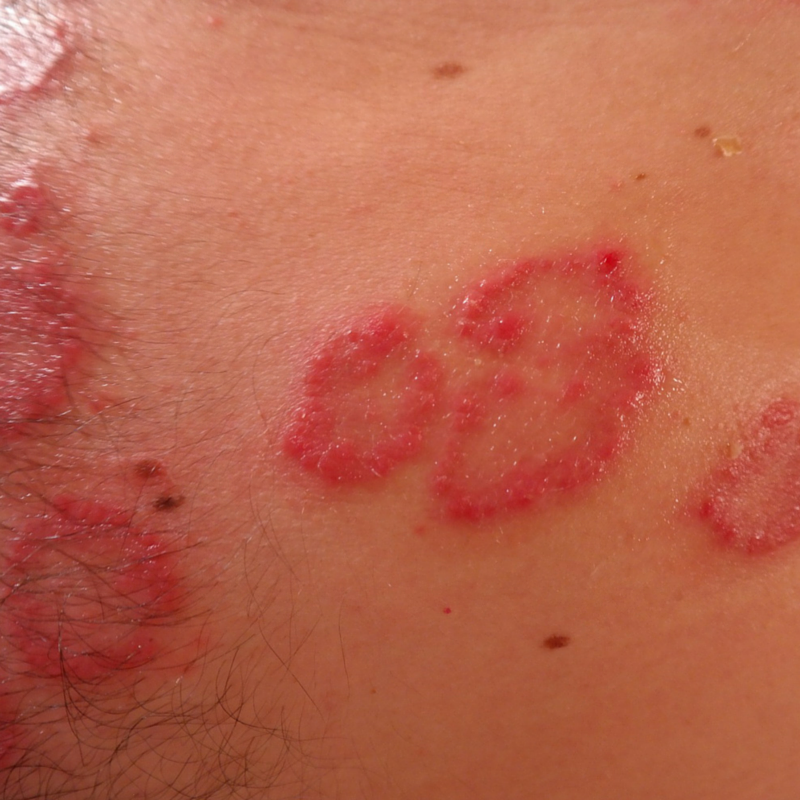

Music that gives you goosebumps is nice, but not if you have psoriasis. Just like lovely warm summer weather or real winter cold. This is because in this autoimmune disease, something happens in the skin that makes it a little thicker in some places, which can make normal skin reactions painful or cause itching. This makes it difficult to live a normal life that you can enjoy to the fullest.
To make sure you can enjoy yourself despite psoriasis, in this article I will go over what psoriasis is and how treating psoriasis can be supported with mindfulness.
What is psoriasis
Psoriasis is an autoimmune disease that presents distinct symptoms to the skin. Because of this autoimmune disease, faster cell division takes place in some parts of the skin and the cells also mature more slowly, giving you thicker pieces of skin that have a stiffer texture than healthy skin.
In northern Europe, about 3 percent of the population suffers from psoriasis. That means that out of every 33 people, there is 1 person who suffers from psoriasis. So it could very well be that in every school class you have a student who suffers from this skin disease.
Psoriasis usually develops before age 40, and most people have a genetic predisposition to it.
What makes psoriasis bother you more?
Sometimes you've gone through your entire growing up life without psoriasis and you may suddenly suffer from this autoimmune disease. There are several triggers that can cause this:
- Wounds
- Infections
- Medicine
In addition, medics also believe that stress, smoking, climate and some cancers can trigger psoriasis. There is also evidence that gluten can aggravate psoriasis.
Treatment of psoriasis
Currently, psoriasis is mainly treated with topical creams, light therapy, and diet and lifestyle changes.
Changing diet involves examining which foods cause psoriasis to get worse and which foods cause it to actually get less. In general, this means eating fewer products with flour in them, such as bread and pizza, and more fruits and vegetables.
Depending on the type of antibodies a person with psoriasis has, a gluten-free diet may help reduce psoriasis. This is shown in a study conducted on 33 people with psoriasis in which one half continued to follow a normal diet and the other half stopped eating gluten(1). After only 3 months, there appeared to be a significant difference between the two groups.
In addition, adding fish oil and krill oil in the diet can also reduce psoriasis. If you have a low-fat diet while eating 30 ml of fish oil a day for four months you have a nearly 80 percent chance of reducing psoriasis. This is according to a study(2) involving 30 patients.
Lifestyle change, for example, involves quitting smoking and consuming less alcohol. Smoking can cause psoriasis to start and get worse. Despite obesity often being linked as a risk for developing psoriasis, obesity appears to occur more often after the onset of psoriasis and therefore cannot be seen as a cause(a, b). However, obesity can cause arthritic psoriasis. Therefore, if you are overweight, it is still important to take steps to achieve a normal weight.
In addition, stress can also have a negative effect on psoriasis. If stress can be reduced, it is always recommended.
How can mindfulness help with psoriasis?
Mindfulness can support psoriasis treatment in multiple ways, both directly during treatment and indirectly.
Light Therapy
Psoriasis is often treated with light therapy that reduces the appearance of psoriasis patches on the skin. Research(3) found that if patients applied mindfulness meditation during their treatment they had much faster results than subjects who did not apply mindfulness meditation during treatment.
Lifestyle Change
If you suffer from psoriasis, you also have an increased risk of stress. This is because there is often still a stigma attached to psoriasis. After all, it looks different than normal and people who don't know about it may fear that it is contagious. This can create unpleasant situations and affect your self-confidence.
A feature of this is that you want to hide psoriasis on the arms, for example, while the sun, provided you don't burn yourself, can even provide good effects against psoriasis. Of course, by hiding your psoriasis you do prevent people from reacting annoyingly, but in the summer months this can cause extra sweating. All things that you need to take into account and can cause stress.
Mindfulness helps reduce daily stress . Research(4) shows that when mindfulness is used to reduce stress in addition to using the normal treatment for psoriasis it can cause an improvement in the disease, i.e., you suffer less from psoriasis.
There are several ways mindfulness throughout the day can help reduce stress, such as mindfulness meditation during housework, walking, and mindfulness yoga.
Stress is often the result of thoughts about the future or a past event. Applying mindfulness ensures that your attention and thoughts are in the here and now. One way this is done is by paying attention to and listening to the signals your body gives.
Mindfulness exercises for your lifestyle
Muscle tension, for example, can be a sign of stress. Performing a body scan will help you detect that muscle tension and reduce it, which will also help you relax.
In daily activities, such as vacuuming, your thoughts can quickly drift to stressful situations. By applying mindfulness meditation, you make sure those thoughts come up less, and when they do come up, you make sure those thoughts have less impact.
This is because you are engaged in experiencing the activity completely. The sound of the vacuum cleaner, the feeling of it sucking on the surface, the motion you make to move the vacuum cleaner through your home. Thoughts that bother you you name and then you focus again on the task at hand.
You can also do this while folding laundry, walking, and other daily tasks.
Change of diet
Eating healthier can sometimes be very difficult, and mindful eating can be a solution to that. If you have quite a sweet tooth, it is sometimes difficult to resist a snacking moment. In addition, thirst and boredom are also easily confused with cravings and hunger.
Therefore, a first simple step is to drink a glass of water when you are hungry. This can be the solution, but sometimes mindfulness is also the solution.
When you feel like eating something go over how you feel and why you feel like eating something. That way, you can find out that boredom may be the cause for you why you open a bag of chips.
Mindful eating
When you're hungry go over, what you're doing, how your body feels and what emotion you're experiencing in that moment.
- Step 1: You get an appetite
- Step 2: You name what you are doing, such as watching television, working, cleaning etc.
- Step 3: You check how your body feels, checking if you are flabby and if you have a full or empty stomach.
- Step 4: You identify what emotion you are currently experiencing.
By performing these 3 steps each time the first step is started by your subconscious or body, you can find out if you are eating because of an emotion or real craving. This makes it easier to eat less when necessary.
Then, if you start eating because you're just really hungry, you can apply techniques of mindful eating. By eating mindfully, you stimulate all your senses.
- You look at the food first and can enjoy the colors and textures that way.
- You can smell the delicious aromas of your food which is already making you notice that your saliva production is starting up.
- Then take a bite and enjoy the flavors and feel the change in texture and release of new flavors as you chew your food.
- You swallow it and feel the bite fill your stomach and provide your body with important nutrients that reduce inflammation and immune system reactions.
Eating mindfully makes it easier to eat lots of fruits and vegetables because you can really enjoy the flavors and textures. In addition, you notice that you never eat just anything anymore which also signals you are full sooner.
Want to learn more about how mental techniques can improve quality of life? Then stop by a seminar or check out Hypnosis Institute Netherlands' training programs.
Sources:
http://europepmc.org/abstract/med/2563604
http://archderm.jamanetwork.com/article.aspx?articleid=401808