


Relativization is an art that can sometimes come in very handy in life. Turning every gnat into an elephant can cause a lot of stress. Every stimulus in your life causes a chain of reactions if only in your mind. This can create an awful lot of turmoil in your mind and trigger emotions that are not calming. Being able to put problems and events into perspective prevents unnecessary stress.
Therefore, in this article I will discuss what relativization is and how you can learn to relativize.
What does perspective mean?
Relativize is not a character trait, but a verb. Relativization is something you can learn. It involves the art of putting a problem into new perspective with the goal of making the problem smaller or seem smaller.
For example, if you often turn a mosquito into an elephant, the goal is to turn that elephant back into the mosquito by putting things into perspective.
A few examples of relatable products are:
You have to sell your car due to circumstances that leave you thinking you no longer have a means of transportation.
You can put this problem into perspective by thinking that public transportation in the Netherlands is also very good and you can reach most places by bike as well.
With this way of putting things into perspective, the problem of not having your own means of transportation seems smaller because there are alternatives.
Another way to put this problem into perspective is to say:
At least I don't have to sell my house.
By contrasting your problem with a larger problem that does not bother you, you can experience a sense of relief while still being in a less fun situation.
For example, a common comment made by others to help you put things into perspective is that your problem is not the end of the world. This can be very annoying at such times because you feel that your problem is the end of your world. If this upsets you completely, it is important to learn to put things back into perspective.
Unable to relate
If you find it difficult to relate, it is important to take a look at what is actually happening at a time when you really should be relating.
Not being able to relate can lead to a panic attack if you have a problem that seems insurmountable.
By not being able to put things into perspective, you may think, for example, that if you have to sell your car you will lose your job because, after all, how will you go to work? Then you make the connection that if you lose your job it will cost you your house, because what do you pay that rent from? Then comes the connection that without a house you totally fall down the social ladder, people no longer want to be associated with you, and you end up wandering the streets alone without a roof over your head in social isolation.
That way, having to sell your car can become a problem that for you means being homeless and without friends, when that is not an issue at all.
Not being able to put this into perspective and keep making connections can have a paralyzing effect. The problem becomes so big that you can no longer see the solution. This is also where the phrase "can't see the forest for the trees" comes from.
This keeps you worrying about the problem instead of working toward a solution. This working toward a solution can already have a relativizing effect.
Not being able to relate does not automatically mean you are emotionally hypersensitive. If you are emotionally sensitive, fears and worries may be triggered more quickly, but everyone suffers from not being able to put a problem into perspective from time to time.
Learning to relate
Not being able to relate doesn't mean you can never relate. It can also mean that in certain areas of your life you find it difficult to relate. For example, this blockage can occur with problems in the following spheres.
- Work
- Relationships
- Money
- Home
- Family
- Friends
To learn to put things into perspective, the first thing to know is in what areas of your life you find it difficult to put problems back into perspective.
Still, if you find that with every problem you can make the problem disproportionate, there may be more to it.
Finding out cause of inability to relate
During hypnotherapy, the therapist can help you identify the area in which you find it difficult to relate and why this is so.
For example, the blockage may have occurred sometime in your life when someone explained the importance of a certain situation to you and it penetrated deep into your subconscious.
In addition, you may have certain beliefs that change your outlook to the point where relativization becomes difficult.
In either case, a hypnotherapist can help you identify the cause. For example, if this has been a particular event in your life, it can be done with regression therapy.
On the other hand, the hypnotherapist can drill down to why something is going the way it is.
In some cases, you may also find that when a problem arises in a particular corner, a particular ritual accomplishes itself. For example if your family has a problem with you or you have a problem with your family you may have the same type of behavior and thoughts every time making the problem bigger than it is.
During hypnotherapy, this ritual can be mapped and broken, allowing you to work on solving the problem sooner in the future.
Techniques to better relate
Relativizing initially means stopping making the problem bigger. You stop all those connections of problems that are bigger than the current problem by being in the here and now. One way to do this is with mindfulness.
Mindfulness
With mindfulness, you monitor your thoughts. If you find that your thoughts are making the problem bigger than it is, it is important to focus on the here and now. One way to do this is to close your eyes for a moment and take a deep breath(1).
Taking a moment to feel the connection with your body and walk past all your senses also reconnects you to the here and now and keeps your mind from going to future predictions.
Next, you can look at what you do have.
Looking at what you do have
The song "Ain't got no, I got life" by Nina Simone makes it very clear that problems can mean anything, but that if you live there is really nothing to worry about.
By looking at what is not a problem, the problem you are trying to put into perspective becomes a lot smaller and has much less impact on your life and thoughts.
What can you do about it?
Something else you can do to put into perspective is to ask yourself whether or not you can do anything about the problem. As in the example of the car, the solution is to take the bike or use public transportation, buy a moped or perhaps carpool with a colleague. Those are already 4 alternatives.
If you can't do anything about it, it is especially important to let go of the problem, otherwise it will only frustrate you.
Compare yourself to the universe
Sometimes a problem seems very big, but when you see the place Earth, humanity and man play in the universe, we are just dust in the wind. What we do doesn't really matter to the universe. The earth keeps turning, the universe keeps expanding. So that car that needs to be sold doesn't matter(2).
Being able to relate too well
The last technique in which you compare yourself to the universe is not always a good one. If you can relate too well, it can lead to neglect of yourself and your relationships. If you can relate very well, it can even depress you because nothing matters anymore.
On the other hand, this can be very liberating because you will experience much less stress and be able to enjoy your life more.
Relativize for the right proportions
So it is important to see problems in the right proportions and see them for what they are(3). Relativization is important to keep an overview and suffer less stress, allowing you to work toward a solution with clear thoughts.
Relativizing should not lead you to not solve the problem. Relativizing should lead to staying calm and facing problems head on.
Being able to relate properly makes you worry less and allow you to enjoy life more. In doing so, it is a great tool to better solve problems for yourself and others.
Want to learn more about mental techniques that can improve your quality of life and help others? Come to a free online master class on hypnosis or check out the Hypnosis Institute Netherlands' training courses.
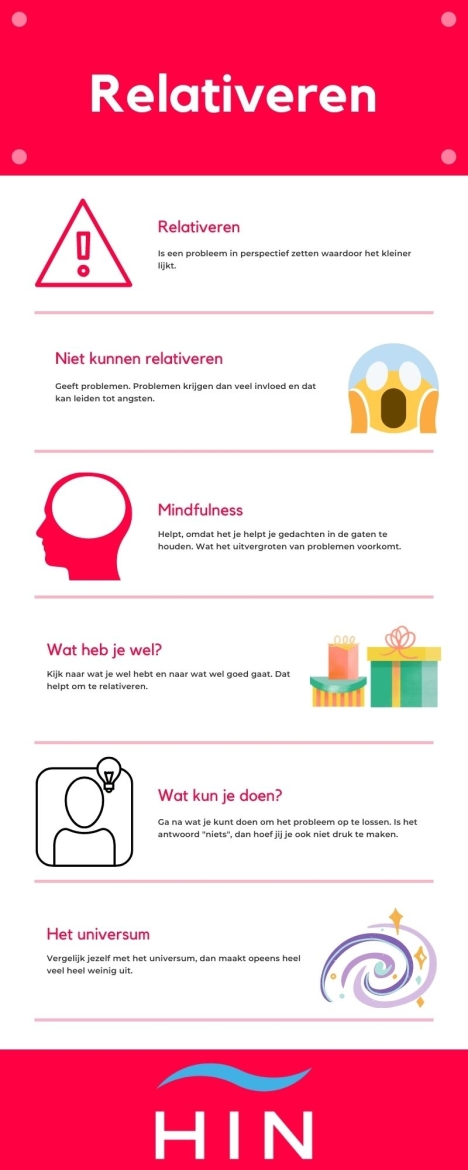
Also pin this handy infographic as a reminder:
Sources:



