


Autism is a difficult and frustrating condition, both for the person with autism and those around them. Information processing runs differently than in people who do not have autism. On the one hand, this has all kinds of advantages; for example, people with autism often have an eye for detail, are honest, hardworking and analytical. On the other hand, it has disadvantages. It is difficult for people with autism to keep track of things, have social contacts and often they only have a limited number of interests.
You can't cure autism, but it can cause all kinds of problems. By applying mindfulness, it is possible to better address those problems.
Now if you think people with autism are stupid you are wrong. As with people without autism, people with autism can have high or low IQs. Over 1 percent of all Dutch people have some form of autism. In this article I will discuss mindfulness for people with all kinds of autism and of varying severity.
Mindfulness with an autistic child
Autism in a child can be annoying in that they sometimes become physically aggressive. This is not only bad for their own quality of life (if they hit themselves, for example), but also becomes annoying for the parents and any siblings if the aggression is directed outward.
It is not always clear why this happens. Generally, frustration is assumed to cause an autistic child to become aggressive.
Sometimes children and adults with autism can also hit themselves. People with autism report that they do this not only because they are frustrated, but also hit themselves because of strong emotions, such as anger or sadness, or stress.
The experience of 1 person was that she beat herself when she felt she was not behaving as her mother expected of her, but that those problems ceased the day she moved out on her own.
Of course, a person should not hit himself or herself in order to properly deal with emotions. Therefore, mindfulness can be a good way to give your child an alternative.
Research shows that children between the ages of 11 and 18 who learn mindfulness gain a better quality of life as a result. They can better manage their emotions and verbalize them as well.
Mindfulness for parents of children with autism
Multiple studies (1, 2, 3, 4) also show that if parents apply mindfulness in their parenting it can reduce some aggression problems in children with autism. So it is not necessary for your child to practice mindfulness. One study that looked specifically at the role of the mother and the child's aggression problems found that if the mother uses Mindfulnes Based Positive Behaviour Support it reduced the child's aggression.
The mothers themselves used meditation to reduce stress and PBS to encourage the children in good behavior and distract in bad behavior.
Multiple studies show that parents of children with autism experience more stress than parents of "normal" children and chronically ill children. Mindfulness can also be a way for parents of children with autism to relieve the stress of parenthood. Research shows that it helps even better than learning techniques to deal with your child differently. Although that also had promising results.
Research also shows that mindfulness parenting, in which parents use techniques of mindfulness during parenting, made children less aggressive and recalcitrant. In the process, the children were also less likely to hurt themselves.
This includes ensuring that when you interact with your child, you are focused on that moment and not thinking about something else in the meantime. It is also important not to avoid difficult situations, but to accept them. Just as you don't judge thoughts during a mindfulness meditation.
The role of the father has also been studied, and if they parent more mindfully, it seems to strengthen the bond between father and child and also help with positive child development.
It also works well for children and parents to learn mindfulness at the same time.
Mindfulness in a (young) adult autistic person
As children mature with mindfulness, they also learn more and more about their strengths and weaknesses. However, because of this growth of self-awareness and developments in the social world, they are also more likely to experience brooding, anxiety and depression in their lives.
People with autism also suffer from depression and anxiety relatively more often than those without autism (5). Research shows that brooding, anxiety and depressive feelings in people with autism can be reduced by mindfulness focused on autism issues. In this study, the results of mindfulness against brooding and anxiety were the most promising. It should also be mentioned that this study used subjects who could communicate in an average or above average manner.
Worrying does not always have to be detrimental for people with autism. It can also be used to put social interactions into perspective. For example, if someone made a joke that the person with autism took literally, brooding can provide a realization about that joke.
For example, with mindfulness for autism, there is less dwelling on thoughts during mindfulness meditation, but rather acceptance of those thoughts. There is also less use of metaphors to explain mindfulness, because people with autism often take language literally. In this study, 42 adults with autism learned more about mindfulness body scan, mindfulness meditation, mindfulness walking and mindfulness eating in an 8-week program. This program was based on Mindfulness Based Stress Reductio (MBSR), but with modifications to better fit the issues being treated.
In addition to fretting, anxiety and depression, people with autism problems can also become aggressive.
Research(6) shows that mindfulness for people with autism can also help them become less aggressive. Three young adults with autism participated in this study. The exercise they were given was to when they became aggressive they would shift their attention from the point from which they were becoming aggressive to a calm place in their body, in the case of this study the soles of their feet. Their mother taught them these techniques. So the attention was shifted from the emotion to the bottoms of their feet.
Before the study, participants had 14 to 20 aggression problems per week, but already during the study this was reduced to 4 to 6 times per week and in the last four weeks of the program they had no more problems with aggressive behavior.
The subjects then had a check up of sorts for 3 more years that showed they only had one more problem with aggression. The researchers conclude that people with autism can learn mindfulness techniques in order to stop experiencing aggression for several years.
Mindfulness vs. Cognitive behavioral therapy in autism
Mindfulness works better than cognitive behavioral therapy for autism. This is because cognitive behavioral therapy involves changing the train of thought. Research shows that for people with autism, this idea is difficult to understand and is hardly applied in everyday life.
While mindfulness involves only keeping your thoughts in the here and now and focusing on your body and breathing and not making judgments about your thoughts. So nothing needs to be changed, only calmed and in the here and now.
Mindfulness exercises for people with autism
Studies have used several exercises that people with autism can apply, namely:
Mindfulness moment, but without naming the thought. Just the emotion and accepting it.
Five-minute mindfulness meditation, where attention is focused on breathing and thoughts and feelings are accepted.
Mindfulness yoga
Mindfulness Walk
Mindfulness distraction from emotion, in this case it is important to shift the attention of the person with autism from the emotion to the bottom of the feet. To the feeling of the weight of the body resting on the soles and to breathe calmly in the meantime. This technique has been used in almost all studies on the effect of mindfulness on people with autism, in both adults and children.
Want to learn more about how mindfulness can improve your life and that of your child? Then stop by a seminar or check out Hypnosis Institute Netherlands' training programs.
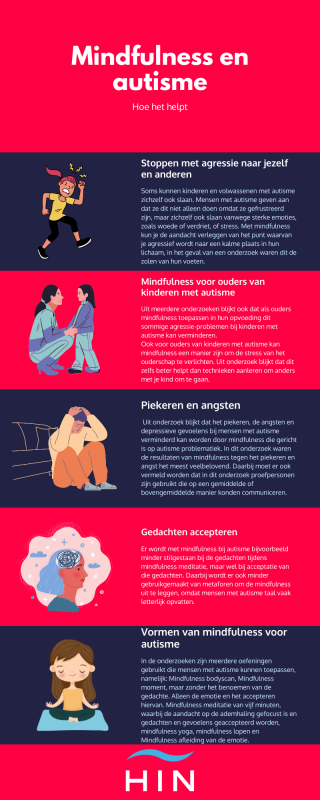
Also, pin this infographic as a reminder:
Sources:
http://wrongplanet.net/forums/viewtopic.php?t=115648
http://www.sciencedirect.com/science/article/pii/S1750946711000067
http://www.sciencedirect.com/science/article/pii/S0891422212002156
http://link.springer.com/article/10.1007/s12671-012-0099-0
http://ebx.sagepub.com/content/14/3/169.short


