Sleep paralysis is incredibly scary for the people who experience it. You are awake, but you cannot move at all. This can last longer than you want, which is what makes it so scary. It can come with symptoms such as hallucinations[1] that don't make things any better. There is much debate about what is now the best approach on how to deal with sleep paralysis and what causes sleep paralysis. In this blog, therefore, I will discuss what sleep paralysis is, the cause of sleep paralysis, the treatment of sleep paralysis and how hypnosis can play a role in this.
The cause of sleep paralysis
Sleep paralysis is a solution your body has devised to allow you to dream safely. In your REM sleep, the phase when you dream, your body prevents you from literally making the movements in your dreams by paralyzing your body. Sometimes you can still wake up while you are dreaming, and that is when you can become aware of sleep paralysis. Because you are still half dreaming, you can also start hallucinating during such a semi-conscious state. For example, people experience the feeling that they are not in their own body or that someone is in their room[2].
About 1 in 5 people suffer from sleep paralysis at some time or regularly,2.
You are more likely to suffer from sleep paralysis if you suffer from the following conditions.
- High blood pressure
- Daytime sleepiness while sleeping well
- Regular sleep deprivation
- Narcolepsy
- Sleep Apnea
- Alcohol Use
- Wilson's disease
- Irregular working hours
- Sleeping on your back
- PTSD
- Fears
- Panic Disorders
- Dissociation
- Belief in the paranormal[3]
Treating sleep paralysis
Generally, medications used for sleep paralysis include those that inhibit serotonin reuptake and even GHB. Since this is still a drug that can be addictive, psychological help is recommended instead of using medication.
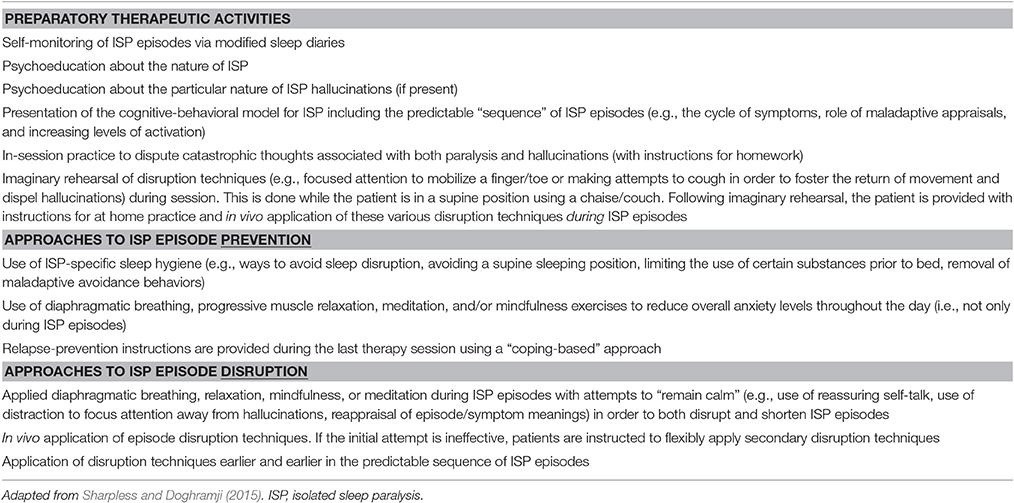
In recent studies, researchers contradict each other,1. One expert says that you should not resist paralysis and instead engage in muscle relaxation exercises[4] while another expert believes that it is okay to take action to try to move, namely by trying to move a finger or toe and by trying to cough1.
Both techniques use cognitive behavioral therapy and can be done in conjunction with hypnosis[5],3.
In addition, beliefs about how normal it is to suffer from sleep paralysis must also be reinforced. Feelings of going crazy or something similar must be reduced,3.
Since there are apparently multiple ways to Rome to suffer less from sleep paralysis, I explain a few exercises and how hypnosis can help.
Relaxation exercises times sleep paralysis
Inducing hypnosis requires a relaxation exercise. Especially if you have a lot of tension in your body, controlled muscle relaxation helps for this. Precisely because you cannot move during sleep paralysis, you can properly focus on relaxing your muscles instead of tensing them.
You mentally go through your body to consciously relax tense areas. You start at your toes and mentally check your body all the way to your crown. Relaxing also already reduces feelings of anxiety, as those feelings can also be amplified by tension in your body,2.
Also, try breathing through your belly. This helps get more oxygen into your body.
Practicing movement during sleep paralysis
The very research that recommends trying to move during sleep paralysis reports that practicing movement is important to do so during sleep paralysis as well,1.
Practicing coughing or moving a toe can be done with hypnosis. For example, with a guided visualization in which you imagine yourself suffering from sleep paralysis. Then you start practicing consciously coughing or consciously moving your toes or fingers. Practicing this will give you more confidence that you can do this later in real life and will increase the likelihood that you will be able to move again and nullify the sleep paralysis. You do this exercise while lying on your back[6].
A guided visualization can then go as follows:
"You lie in your bed and while dreaming you notice that you become aware of your surroundings. You are awake but cannot move because your body thinks you are still in REM sleep. You are aware of this and through this you understand that feelings you have regarding other people in your room are not correct. You breathe calmly and try to relax your muscles. Then you start trying to wiggle your big toe. If this succeeds or fails you try coughing. You alternate this and pretty soon you notice that you have control over your hands and feet and the coughing. This spreads the sense of control to the rest of your body."
This is just an example of a guided visualization. Depending on the symptoms you experience during sleep paralysis, you can get a different guided visualization from your hypnosis expert to suffer less from the symptoms.
Through this exercise, you're making sure that your muscle recognition is on. That what you literally try now will also succeed faster at times when you really suffer from sleep paralysis.
Changing beliefs about sleep paralysis
Changing beliefs about sleep paralysis can also be done with hypnosis. Before the expert starts working on this, you have a conversation in which you can express your feelings and opinions about sleep paralysis. For example, if you find it abnormal and think the paralysis is driving you crazy, it is important to express this so the hypnosis expert can help you with it.
Ultimately, as many as 1 in 5 people suffer from sleep paralysis, so it's much more normal than you might think.
You will then receive hypnotic suggestions that you repeat to yourself daily during self-hypnosis or take along on an mp3 that helps you apply self-hypnosis.
These may include suggestions such as:
"There are a lot more people who suffer from sleep paralysis," he said.
"The feeling that someone is in my room are neurons going haywire."
"I'm just dreaming while I'm awake."
"I don't have to be ashamed of my sleep paralysis."
These suggestions are just examples; depending on your beliefs, you may receive other suggestions to take home. At home, you then find a quiet and comfortable place to apply self-hypnosis. This involves using relaxation exercises before repeating the suggestions.
You can practice this first with the hypnosis expert before taking it home.
Having sleep paralysis can be incredibly annoying. It can cause anxiety about going to sleep, which of course doesn't help either because sleep deprivation can be a cause of sleep paralysis. Therefore, it is also very important to have good sleep hygiene, 3.
Good sleep hygiene includes not drinking caffeinated beverages starting at noon. Having a dark bedroom and not looking at a screen for a few hours before bedtime. You then also dim the lights in your home or turn on some twilight lamps instead of a big light.
All in all, then, sleep paralysis can certainly be treated so that you suffer less. There are many practical things you can do to be less bothered by it, and in addition, hypnosis can also play an important role in practicing to regain control of your body and to reassure yourself that there isn't actually that much going on.
Want to learn more about exactly how hypnosis works? Then come to the free online master class on hypnosis or take a training course at the Hypnosis Institute Netherlands.
Pin this infographic as a reminder:

Sources:
[1] https://www.frontiersin.org/articles/10.3389/fpsyg.2017.00506/full
[2] https://www.ncbi.nlm.nih.gov/pmc/articles/PMC5329044/
[3] https://www.ncbi.nlm.nih.gov/pmc/articles/PMC4958367/
[4] https://www.frontiersin.org/articles/10.3389/fpsyg.2016.00028/full
[5] http://orca.cf.ac.uk/48559/
[6] https://www.frontiersin.org/files/Articles/235785/fpsyg-08-00506-HTML/image_m/fpsyg-08-00506-t001.jpg